
REVIEW · PRAGUE WALKING TOURS
Private Prague Art Nouveau and Cubism Walking Tour
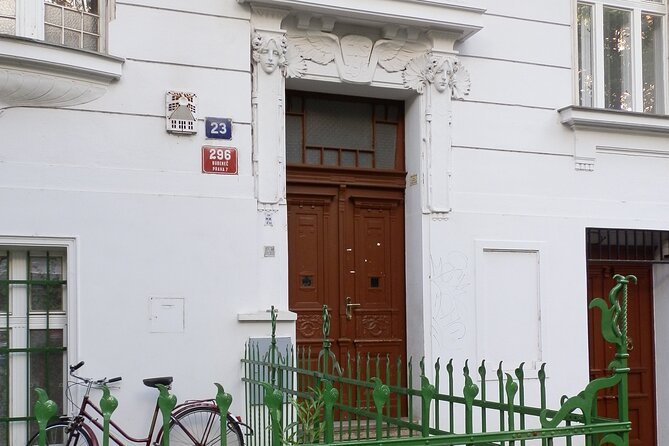
Art Nouveau and Cubism in one walking loop. I love how the tour teaches you to see styles fast, especially the shift from flowing ornament to sharp, angular Cubism, and I love that it is led by Max Hutar of Prague Articulate, who tells it in a way that makes the buildings click. One thing to plan for: there is plenty of walking and short transit hops, so it can run a bit longer than the advertised 2 hours 30 minutes.
Because it is private (your group only, up to 15), it is an easy way to get oriented without hunting down buildings on your own. You get a mobile ticket, the tour is offered in English, and it finishes at the Albertov tram stop, with the public-transport ticket they use still valid long enough to get you back toward the center.
Key highlights you will notice right away
- Start inside the drama of Prague Main Station, then move outward to Art Nouveau and Cubism in a tight route.
- A guide who narrates the why, not just the what, so you learn to spot style clues on the street.
- Cubism on purpose, including the famous House at the Black Madonna and the Three Cubist Houses near Vyšehrad.
- Street-level details count, like Emil Kralicek’s Cubist lamppost that most people speed past.
- Great time management for a niche topic, mixing short stops, quick walks, and at least one transit leg to keep momentum.
How This Private Prague Architecture Walk Works
This is a private walking tour built around early-modern Prague, with a clear theme: Art Nouveau first, then Cubism. The route is compact enough that you keep moving, but not so packed that every stop feels rushed. Expect short walks between sights, plus at least one moment where you use public transportation to cover ground efficiently.
The time on the clock is about 2 hours 30 minutes, give or take, which is normal for a tour like this where the labeled stop times do not include the in-between strolling. You should also assume you will linger a bit. The guide’s pacing is part of the value, because architecture is hard to appreciate when you are just snapping photos while walking.
The tour is in English, and it is priced per group at $94.93 (up to 15 people). That matters, because you can split the cost among friends or family and end up with a very reasonable architecture-focused “intro session” compared with paying for multiple separate entries and guides.
You can also read our reviews of more walking tours in Prague

Price and Group Value: Paying for Focus, Not Tickets
At $94.93 per group (up to 15), the price is not about buying museum access for everyone. It is about getting a structured route, a guide who can read the city for you, and help spotting design choices you would probably miss alone.
Here is how to think about value:
- You are paying for interpretation. Art Nouveau and Cubism are not always obvious at street level unless someone shows you what to look for.
- You are paying for a time-efficient route. The sights are spread across key areas, and the tour uses short transit hops so you do not burn half your day getting between neighborhoods.
- You are not stuck with a single long interior museum. Many stops are exterior views, so you keep the walking manageable and the day flexible.
One practical note: not every stop has admission included. Some are marked as admission not included, so if you plan to go inside those places, factor that into your day. Even if you mostly view from outside, you still get a lot from the style comparisons across the route.
Stop-by-Stop: Praha hlavní nádraží to Neklanova
I like this route because it teaches you a progression. You are not just collecting pretty buildings. You are moving through a timeline of style experiments, from ornament-heavy Art Nouveau to the fractured geometry of Prague Cubism.
Stop 1: Praha hlavní nadrazi (Prague Main Station)
You start at Praha hlavní nádraží, the central station opened in 1909. It is a standout early-modern landmark, and the recent reconstruction has helped bring the halls and corridors back to life visually.
Why it works on a tour like this: you get placed inside a “big idea” building first. Stations are often where cities show off, and this one is no exception. Take a few minutes to study the interior lines and details before you head into the street. It gives your eyes a starting point for what Art Nouveau looks like in Prague scale.
This stop is listed as about 15 minutes, and admission is free for this part.
Stop 2: Jerusalem Synagogue
Next comes the Jerusalem Synagogue, built in 1906 with a traditional Moorish look that also includes Art Nouveau-style elements. It is only a short stop (about 5 minutes), but it is a useful reminder that “Art Nouveau Prague” is not just one uniform aesthetic.
What you can watch for here is the mixture of influences. When a building blends styles, it teaches you how artists and architects thought at the time. That makes later Cubism easier to understand, because you start seeing Prague’s architecture as an active experiment, not a single trend frozen in place.
Admission is not included for this stop, so keep that in mind if you were hoping to go inside.
You can also read our reviews of more private tours in Prague



Stop 3: Senovazne Namesti (Senovážné náměstí)
At Senovážné náměstí, you get a quick look at three luxurious Art Nouveau apartment buildings. This is about close reading, even if you are only there for around 5 minutes.
Why I like this stop: apartment buildings are where Art Nouveau often felt most personal. You are not just looking at a palace or an institution. You are looking at what people lived with, the kind of architecture that shaped everyday street views.
Admission is listed as free here. Use the time to compare the building façades, especially how decoration and structure work together.
Stop 4: Hybernska 10, Hotel Central Palac
Hybernská 10 is the Hotel Central Palace from 1899, one of the earlier Prague examples of the Art Nouveau style. It is a short stop, about 5 minutes, and it is mainly a façade and streetscape moment.
This is a good “calibration” stop. By now, you have seen Art Nouveau in a big interior space and in apartment-style design. Here, you can spot how the style shows up in hotel architecture: refined, polished, and meant to look impressive from the street.
Admission is not included for this stop, so plan to focus on exterior details.
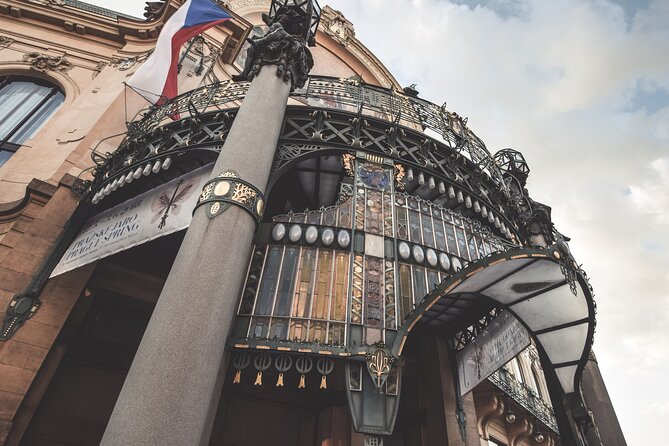
Stop 5: Obecni dum (Municipal House)
Now you hit Obecní dům, the Municipal House. It is projected in 1905 and is still used as a house of culture and representation. It is also described as one of Prague’s biggest and most important Art Nouveau architectural pieces.
You get about 10 minutes here, which is usually enough to take in the overall scale, even if you do not go inside. If you do pause longer, it is worth it. This is the kind of building where your eye can get lost in ornament and then catch back onto the structural rhythm.
Admission is not included, so if you want interior access, you will likely need to arrange that separately.
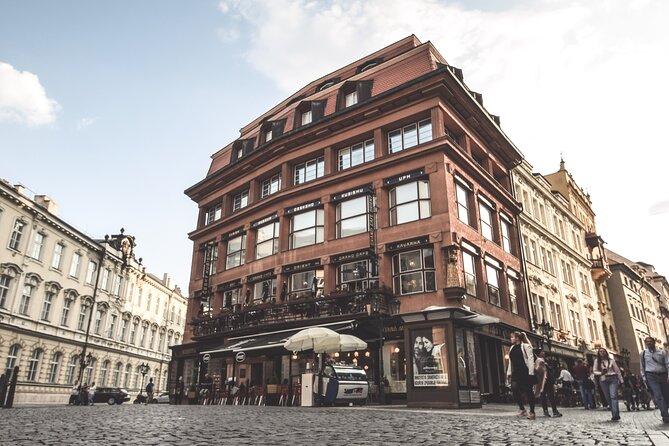
Stop 6: House of the Black Madonna (Cubist flagship)
The tour then flips into Cubism with the House at the Black Madonna (1912). It is presented as a flagship of Cubist architecture pioneered by Prague architects before World War I.
This stop matters because Cubism can feel abstract until you compare it directly with what you saw earlier. Here you can see how the geometry becomes the story, not just decoration. Even from the street, the silhouette and the angular language help you “hear” Cubism.
The stop is about 10 minutes, and admission is not included. Treat it as a visual lesson. If you are struggling to see the Cubism at first, give yourself one full minute and then look again, framing the building like a set of connected planes.
Stop 7: Na PrikopE (the Old Town and New Town border boulevard)
Na Příkopě is a borderline boulevard between Old Town and New Town, and it is lined with banks and other buildings in breathtaking Art Nouveau style. This stop is about 5 minutes.
This is a good segment for quick comparisons. You have one of the most iconic Cubist looks behind you, so now Art Nouveau can feel extra “curvy” and decorative. The boulevard also helps you understand how the styles show up in commercial architecture, where façades are designed to impress.
Admission is listed as free here. Use it for street-view learning, especially if you want to recognize Art Nouveau department store façades and bank-front ornament back in the main center later.
Stop 8: Emil Kralicek’s Cubist lamppost
Emil Kralicek’s Cubist lamppost is one of the most fun stops on the route because it proves Cubism was not only for big buildings. It was also for everyday city objects.
It is listed as about 5 minutes and free, and it is exactly the kind of detail that makes this tour feel like more than a simple hits-and-misses checklist. Street furniture is where you learn how far the style language went into real life.
Even if you do not take many photos, take a moment to look at how the lamp changes the line of the street around it. That is the Cubist idea in miniature.
Stop 9: Vaclavske NamEsti (Wenceslas Square)
Wenceslas Square gets a longer stop, about 20 minutes. It is one of Prague’s central squares with beautiful Art Nouveau hotels and department stores.
This is your “big picture” moment. The square gives you room to orient yourself, and the time helps you notice multiple façades rather than just glancing at one. You can also relax your pace here because the square is wide and you are not squeezed into tight curbside viewing.
Admission is listed as free for this portion. Use the time to practice spotting where the Art Nouveau swirls appear, then see how Cubism starts to show up later as you move across the next streets.
Stop 10: Vodičkova
Vodičkova is where the tour stacks multiple buildings that mix Art Nouveau and Cubist elements. You get about 10 minutes here, listed as free admission.
Why it is effective: it is contrast with continuity. You are not suddenly dropped into a totally different district. Instead, you see how styles can coexist in a walkable pattern, and how street blocks can “switch themes” without you changing neighborhoods much.
If you want to understand this tour’s real purpose, it is here. You start noticing that the city does not label itself. You, with help, learn to read it.
Stop 11: Three Cubist Houses
The Three Cubist Houses are near the rock of Vyšehrad fortress, and they are described as one of the most famous Cubist constructions. This stop is about 5 minutes, and admission is listed as not included.
Because it is short, you should focus on the overall set rather than details. Try to view them like a single composition. Cubism can look like “too many angles” until you step back, then it clicks into a designed whole.
If you want interior access, plan that separately since admission is not included here.
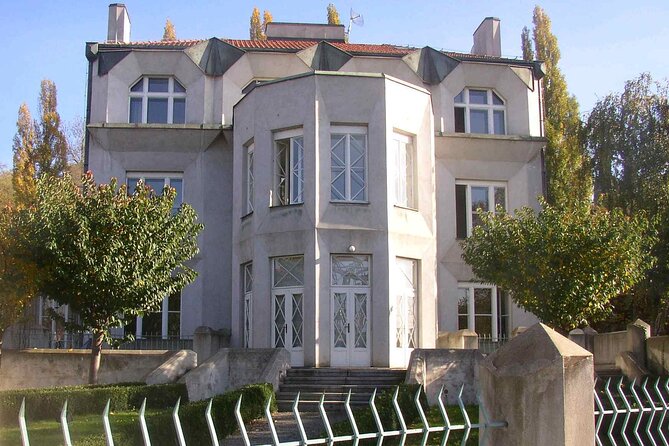
Stop 12: Villa Kovarovic by the Vltava
Villa Kovarovic (built in 1912) is described as a cubist masterpiece inspired by Gothic and Baroque architecture, located by the Vltava river banks. You get about 10 minutes here, and admission is not included.
This stop gives you breathing space because the river setting helps your brain separate buildings from street noise. It is also a useful lesson in how architects borrowed from older styles while using Cubist geometry. That combination is easier to understand with a bit of open space around you.
If your plan is mostly exterior viewing, you will still get a lot. The “why” of the villa is in the blend.
Stop 13: Neklanova (Cubist apartment building finish)
The tour ends with Neklanova, a street with an amazing Cubist apartment building from 1913. It is about 5 minutes, and admission is listed as free for this stop.
The ending here feels right because you finish where Cubism becomes domestic. This is not just art for public squares and big institutions. You have seen Cubism applied to city life, right where people live.
Once you wrap up, the tour concludes at the Albertov tram stop, where the same transit ticket they use is valid long enough to get you back toward central areas.
What You Learn: Spotting Art Nouveau vs Cubism on Your Own
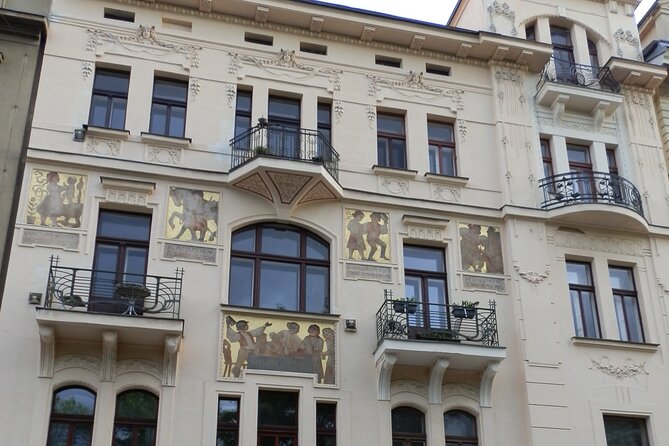
Even if you came in with almost zero architecture vocabulary, you can leave with a real skill. That is the best part of this tour.
Art Nouveau clues you can start watching for:
- Curving forms and decorative detail that feels like it belongs to plants or flowing lines
- A sense that ornament is not just added, it is part of the building’s identity
- Façades that look designed to impress at street level, especially around windows and entrances
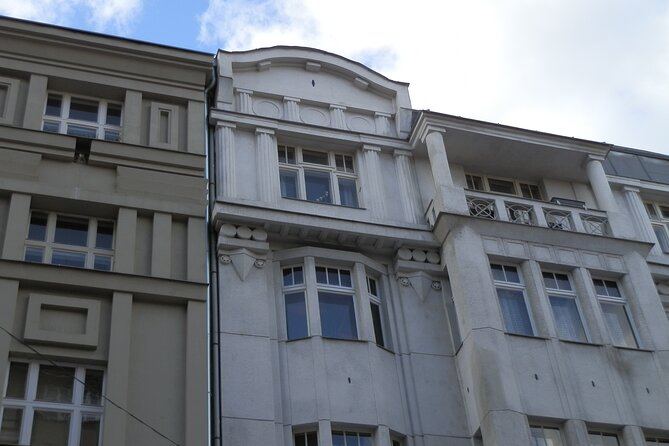
Cubism clues you can start watching for:
- Angular planes and fractured surfaces that change how light and shadow fall
- Building shapes that feel like they were assembled from geometric pieces
- A “structure-first” look, where the design feels like math made visible
The guide’s storytelling is what turns these into recognizable patterns instead of vague impressions. Based on the tour’s format and the range of stops, you get repeated practice: you see one style strongly, then you compare, then you compare again. That is how it sticks.
Practical Tips That Make This Tour Easier
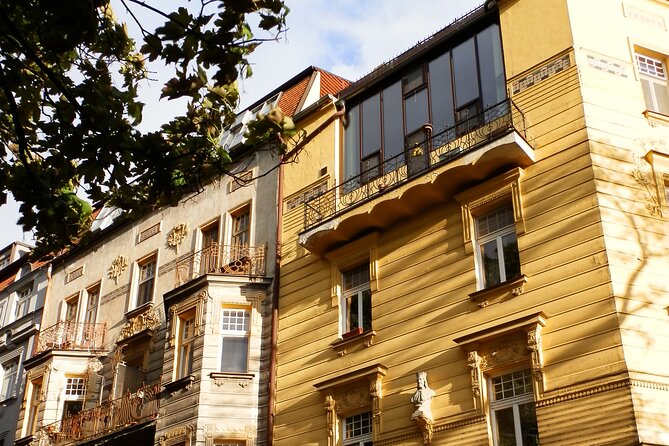
A few things will make your experience smoother, especially if you are the type who likes to stop and look rather than just walk fast.
- Wear shoes you trust. There is walking, and some participants find the total time can stretch beyond 2 hours 30 minutes.
- Plan one extra hour on the day. Not because it will be slow, but because architecture stops take time when something grabs your attention.
- Bring your photo habits, but slow down. For Art Nouveau, wide angles help. For Cubism, take a step back and then re-frame.
- If you want interiors, be selective. Several stops list admission not included. Decide what matters most to you rather than trying to squeeze in everything.
- Use the tram link they finish with. Ending at Albertov is a smart move because you are not stranded across the city from your next plan.
Who This Tour Fits Best
This works best for you if you like design, details, and buildings that tell a story. It is also a strong choice if Prague feels overwhelming and you want a guided way to get oriented without jumping between random museums.
I especially think it fits:
- architecture lovers and design-minded visitors
- first-time Prague visitors who want a focused theme
- people traveling with a mix of art interests, since the route includes both big “wow” landmarks and street-level surprises
It might be less ideal if you prefer purely scenic sightseeing with minimal stops, or if you strongly dislike walking during sightseeing. The tour is meant for people who want to look closely.
Should You Book This Prague Art Nouveau and Cubism Tour?
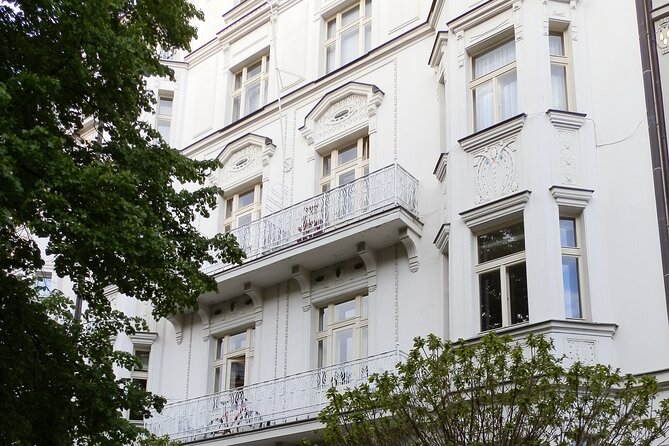
Book it if you want a structured, high-signal introduction to two of Prague’s most distinctive architectural languages. The stop selection hits both famous landmarks and small, memorable details, and the format is built to help you recognize patterns by the end.
Skip it if you are only interested in one broad style, or if you want a very relaxed sightseeing day with no walking and no transit. Also consider your tolerance for stops where admission is not included, since you may need to decide what you are okay seeing from outside.
If you like the idea of ending with Cubism you can actually point to, like the Three Cubist Houses and a Cubist lamppost, this tour is a smart use of time.
FAQ
How long is the private Prague Art Nouveau and Cubism walking tour?
It is approximately 2 hours 30 minutes. The total duration includes short walks between stops and some use of public transportation, so it is normal that the listed stop times do not add up to the full duration.
What is the price for the tour?
The price is $94.93 per group, for groups up to 15 people.
What language is the tour offered in?
The tour is offered in English.
Do I get a mobile ticket?
Yes, it is listed as a mobile ticket.
Where do I meet at the start, and where does it end?
You start at Prague Main Station, Wilsonova 300/8, Vinohrady, and the tour concludes at the Albertov tram stop. The end location is listed as Na Slupi 2102/2b, Nové Město.
Is this tour private or shared?
This is a private tour or activity. Only your group participates.
Is public transportation involved?
Yes. The tour includes short walks and at least one point where public transportation is used.
Is admission included for the stops?
Admission is free for some stops and not included for others. For example, free is listed for Praha hlavní nádraží, Senovážné náměstí, Na Příkopě, Wenceslas Square, Vodičkova, and Neklanova. Admission is listed as not included for places such as the Jerusalem Synagogue, Hybernská 10 Hotel Central Palac, Obecní dům, the House at the Black Madonna, and the Three Cubist Houses.
Can I cancel for a full refund?
Yes, you can cancel for free up to 24 hours in advance for a full refund, based on local time.
More Walking Tours in Prague
More Tours in Prague
More Tour Reviews in Prague

Not for you? Here's more nearby things to do in Prague we have reviewed







Prague Walking Tours, compared.
 ★ 4.73-Hour Walking Tour of Old Town & Prague CastleFrom $305,696 reviews
 ★ 4.4Ghost Walking Tour Where Legends Come To LifeFrom $275,253 reviews
 ★ 4.7Jewish Quarter Walking Tour with Admission TicketsFrom $763,729 reviews
 ★ 5.0Prague Guided Walking Tour and Cruise with Authentic Czech LunchFrom $1023,627 reviews
 ★ 4.6Old Town and Jewish Quarter Guided Walking TourFrom $222,847 reviews
 ★ 4.5Prague Ghost and Legend of Old Town Walking TourFrom $212,630 reviews
 ★ 5.0Prague 3-hour Afternoon Walking Tour including Prague CastleFrom $531,899 reviews
 ★ 4.7Ghosts and Legends Nighttime Guided Walking TourFrom $221,462 reviews
Browse the lists this tour appears in