
REVIEW · OLD TOWN & ASTRONOMICAL CLOCK
Prague Old Town New Town and Jewish Quarter Morning Tour
Prague feels like a living textbook when you walk it. This 3-hour morning tour strings together big-name sights and lesser-known corners, covering both Old Town landmarks and the Jewish Quarter story without wasting time. You start at Wenceslas Square and end in front of the Astronomical Clock, so you finish right where most first-time photos start.
I especially like that this is built for orientation. You get a clean overview of how Prague’s neighborhoods connect, plus context you can actually use later when you pick museums, viewpoints, and neighborhoods on your own. I also like the way the route mixes styles, from gothic and baroque churches to Art Nouveau facades and synagogue history, so you leave with a mental map of what Prague looks like and why.
One drawback to plan for: not every stop’s interior admission is included. Several major sites are listed as not included, so you may need to budget extra if you want to go inside at those points, especially in the Jewish Quarter.
Key highlights to pay attention to
- A practical 3-hour route that focuses on foot travel, so you see the city’s layout fast
- Licensed guiding in English with stop-by-stop stories at recognizable landmarks
- Early starts in the historic core, ending by the Astronomical Clock for easy next steps
- Architecture variety on one walk, from gothic and baroque to Art Nouveau
- Jewish Quarter storytelling that connects medieval history to what you see today
- Small-group experience with a maximum of 20 travelers
Why this 3-hour Old Town, New Town, and Jewish Quarter walk works
If you’re trying to make sense of Prague quickly, this kind of walking tour hits the sweet spot. It is short enough to fit your day, but it covers enough ground that you stop seeing Prague as a pile of separate attractions. You get a feel for the city’s rhythm, where the big squares are, and how the streets lead you from one “era” to the next.
You’ll also like the straightforward pacing. Each stop is time-boxed, usually around 5 to 20 minutes, so you spend your morning moving and listening, not waiting in long lines or wandering without direction. For many first-time visitors, it is a smart way to set your bearings before you go deeper.
Group size matters here, too. With a maximum of 20 people, you are not stuck in a swarm, and the guide has a better chance to keep the group together. Also, the route is designed for “watch, listen, notice,” which works well whether you’re history-minded or just want the city explained in plain terms.
More Prague city tours, river trips, and Czech day trips to compare
Wenceslas Square and Lucerna Arcade: the 20th-century spine of Prague
You start at the Statue of Saint Wenceslas on Václavské náměstí, right by the action. Wenceslas Square has witnessed major revolutions and military parades throughout the 20th century, so it sets a dramatic tone early. Even if you are not into political history, it helps you understand why this central avenue matters.
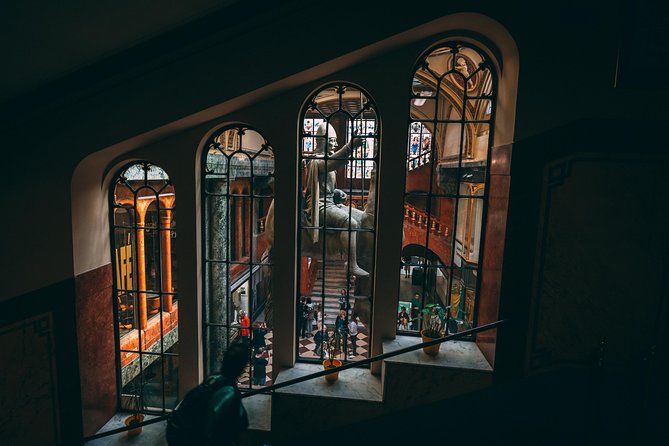
Next comes Lucerna Arcade and the nearby Lucerna Palace area. This is where you get a fun dose of modern Czech design mixed into a historic setting. The guide points you toward the upside-down horse statue associated with David Černý, a detail that makes you look twice at what might otherwise feel like just another shopping arcaded street.
What to watch for on these first stops: look up at facades and signage, not just down the sidewalks. Prague’s “story” is in the buildings, and early in the walk your guide trains your eyes to see style changes as you move.
Franciscan Garden and Church of Our Lady of the Snows: a calm pause with payoff
After the busy central streets, the tour turns toward a quieter stretch: Franciscan Garden. This is the kind of place that feels like a breath of air mid-morning, especially if you’re arriving in Prague with jet lag or cold fingers. The timing is short, but it is meant for resetting your attention.
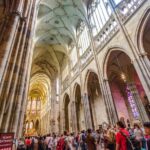
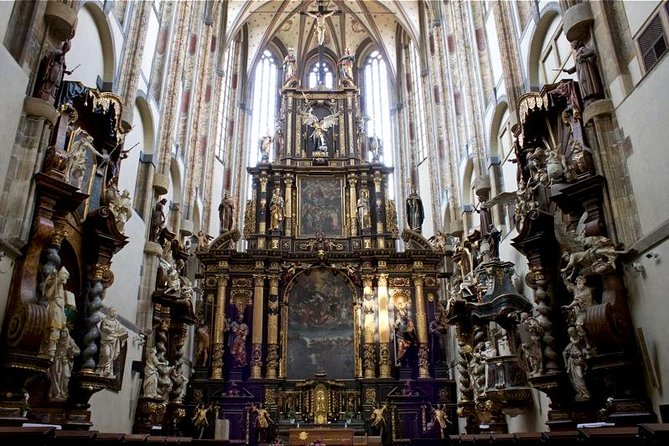
Right by the garden is the Church of Our Lady of the Snows. It is gothic, yet it comes with an unexpected twist: it was planned to become the greatest church in Prague, but it was never finished. I like this stop because it shows you that Prague’s skyline is shaped not just by success, but by interruptions, politics, and changing priorities.
Inside, the highlights are meant to land fast, including its interior and the tallest altar in Prague. Even if you only see part of the church due to crowds, you’ll understand why this building has a reputation for being more interesting than the outside suggests.
Practical tip: if you are visiting in chilly weather, take the church and garden as your natural warm-up points. It is not just sightseeing, it is built-in comfort.
Estates Theatre, Karolinum, and the House of the Black Madonna: culture, learning, and a style you can spot
The Estates Theatre is next, described as the oldest theatre in Prague city centre. You’ll hear about its past and why W. A. Mozart performed in Prague. The story also includes local resistance to the theatre’s construction, which adds a human angle to what could otherwise be a quick exterior photo.
Then you move to Karolinum, tied to Charles University. This is a key stop for anyone who wants more than just pretty buildings. The guide connects it to Charles IV, who is framed as an important figure in Czech history, and it helps explain why Prague’s academic and civic life mattered so much.
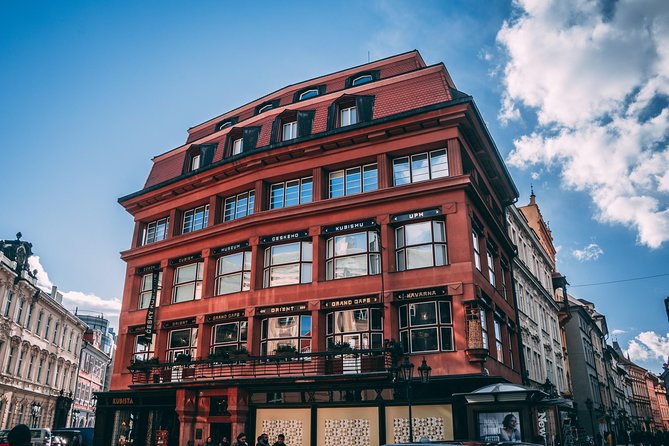
The walk continues to the House of the Black Madonna. Here the focus shifts to architectural identity. The point is not just that the building is unusual, it is that it reflects a Czech style you cannot find everywhere else.
What I’d take from these stops: Prague is not only old churches and royal squares. It is also theatres where culture was debated, universities where power and ideas formed, and streets where design feels proudly local.
Powder Tower, Municipal House, and Church of St. James: Prague’s entrance energy
Powder Tower, also called Prasna brana, is an old “representative entrance” into the Old Town. The tour explains that later it functioned more like a storage facility, which is a nice reminder that buildings change jobs over time. The history is described as having strange turns, and it is a good stop if you like learning how Prague adapted its medieval structures for later needs.
Then you’re by the Municipal House, a standout Art Nouveau stop right in the Old Town orbit. The tour frames it as a pearl of Art Nouveau and focuses on when and why it was built, plus how it is used now. I like this because it gives you a visual break from older gothic and baroque shapes.
Finally comes the Church of St. James. This one is big and baroque, and the tour positions it as the biggest and most beautiful baroque church in the Old Town. Even if you are not a church-inside person, the timing and focus make it easier to commit: you’re not losing half your morning, you’re making a stop that matches the architecture themes of the day.
Tip for photos: take one slow look at each facade before you move on. Municipal House and the nearby church areas reward patient staring, not just fast snapshots.

Spanish Synagogue to the Old-New Synagogue: the Jewish Quarter in context
This is the section that tends to feel like the tour’s “story engine.” You head into the former Jewish Quarter, and the guide is meant to explain why Prague had such large Jewish ghetto areas. The walk is framed from medieval ages to the present day, so you are not only seeing buildings, you are learning what shaped the community over time.
At the first synagogue stop, the Spanish Synagogue, you also get a Prague literary connection. There’s a statue of Franz Kafka associated with the area, which helps anchor the history to something many visitors already recognize. The synagogue stop is paired with the guide’s larger explanation of the Quarter’s development.
Next, you’ll see the Old-New Synagogue, described as Prague’s oldest synagogue. The guide connects its story to the surrounding synagogues, including High Synagogue, Klausen Synagogue, and Ceremonial Hall. This is valuable because it helps you understand why the Quarter is not one single attraction. It is a cluster of religious and community spaces with different roles.
One thing to plan: interior access and admission are listed as not included for these synagogue stops. That does not ruin the tour, but it may affect how much you can do inside versus outside. If you want the full experience of interiors, I’d treat this morning as a “pay once, see more” kind of plan.
Old Jewish Cemetery and Staromestske namesti: memory and the city’s centerline
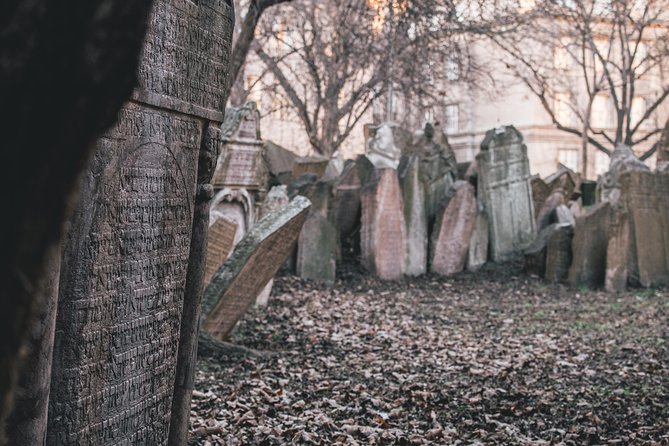
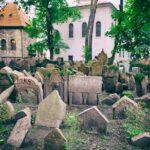
The Old Jewish Cemetery is described as one of the most enchanting cemeteries in central Europe. The guide also points out why it is so extensive and why it survived World War II when many other sites did not. This is the kind of stop that can shift your pace from “tour mode” to slower, more respectful looking.
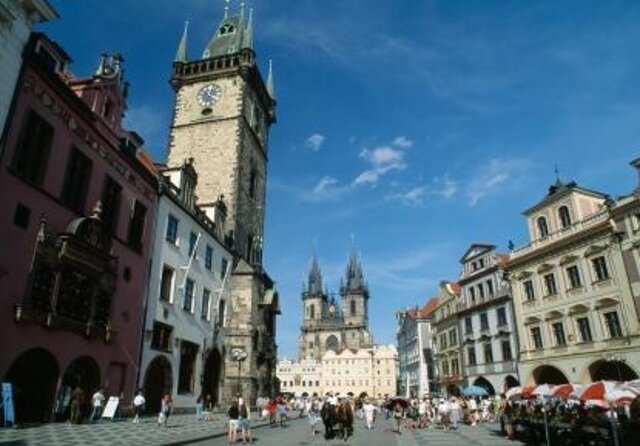
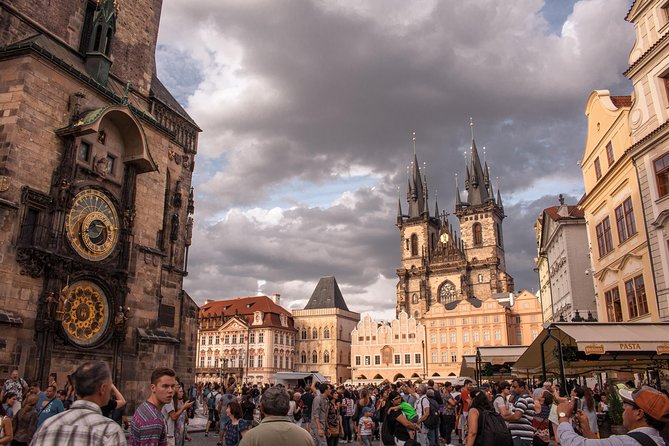
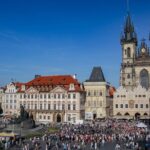
Then the tour opens up again at Staromestske namesti, the Old Town Square. This is the city’s heart, built with layers of architectural styles you can literally walk through. The guide’s stories are aimed at well-known landmarks like the church of St. Nicholas, Týn Church, the statue of Jan Hus, and the column of St. Mary.
I like ending a history-heavy stretch at a place where you can re-orient. Old Town Square gives you immediate visual payoff, and it also sets you up for the next, very famous stop.
If you feel overwhelmed: stand still for a minute. The square is busy, but slowing down helps you spot the details your guide is talking about.
Old Town Hall and the Astronomical Clock: what to expect at the hour show
Your final stop is Old Town Hall with the Astronomical Clock, and the tour ends in front of it. The guide is meant to explain when it was built and how the clock works, then you can watch the hourly show.
This is one of those experiences where knowing the basics makes the show better. Once you understand what you are looking at, the clock stops being just a famous prop and becomes a living piece of engineering and spectacle.
After the tour, you’ll be dropped right in the best spot to keep going. If Prague Castle or another big-ticket area is on your list, this ending point makes it easy to choose your next move.
Practical tip: show up ready to wait a few minutes near the clock if you want the full effect of the hourly moment.
Price, timing, and how to plan your morning on foot
At $32.65 per person for about 3 hours, the value depends on what you want out of it. You are paying for a professional licensed guide and a tight route that packs major neighborhoods into one morning. If your goal is orientation plus story context, this price feels reasonable for Prague’s central-area sightseeing.
What you should budget for is admissions. The tour lists specific stops as free and many others as not included. That means you may spend extra if you plan to enter the theatres, university-related areas, the synagogues, the Jewish cemetery, and the Astronomical Clock interior areas tied to the show timing. If you are okay mostly viewing exteriors, it can still be a strong overview tour.
Timing is another strength. This is a morning tour, and morning light helps with photos and makes the streets feel less chaotic. Booking tends to happen about 29 days in advance on average, so if you’re traveling in peak season, it’s smart to lock in dates early.
Weather-wise, the tour runs in all weather conditions. That matters in Prague because mornings can change fast. I recommend dressing for cold and wind, not just for a comfortable first two minutes.
What to bring that actually helps:
- comfortable shoes for a city walk
- water, especially in warmer months
- a warm layer you can keep on during stops and inside churches
- patience if you’re in a larger group day, because the route is timed
Should you book this Prague Old Town, New Town, and Jewish Quarter tour?
Book this tour if you want a fast, guided overview that connects architecture and history into something you can remember. It is especially useful for first-time visitors who want to learn where things are and how Prague’s neighborhoods relate. If you enjoy standing in front of landmarks and having them explained in plain language, this fits.
Consider skipping or adjusting your expectations if you think the tour is only about the Jewish Quarter. The name highlights it, but the route also covers a lot of central Prague, from Wenceslas Square to Old Town Square and the Astronomical Clock. You’ll likely leave with a broader Prague mindset than a purely Jewish Quarter focus.
Finally, choose this if you like flexibility after the tour. Because it ends at Old Town Square by the Astronomical Clock, you can roll right into your next plans without transferring across town.
If your travel style is: walk, learn, and then roam, this is a strong way to start.
FAQ
Where does the tour start and where does it end?
The tour starts at the Statue of Saint Wenceslas on Václavské náměstí, and it ends at Old Town Square in front of the Astronomical Clock.
How long is the Prague Old Town, New Town, and Jewish Quarter morning tour?
It runs for about 3 hours.
What is the price per person?
The price is $32.65 per person.
Is this tour offered in English?
Yes, it is offered in English.
Is a mobile ticket provided?
Yes, the tour includes a mobile ticket.
How many people are in the group?
The maximum group size is 20 travelers.
Does the tour include admission fees?
A few stops are marked as free admissions on the schedule, while several others are listed as admission tickets not included.
Can I cancel for a full refund if my plans change?
Yes. You can cancel up to 24 hours in advance for a full refund.
Does the tour run in bad weather?
Yes, it operates in all weather conditions, so you should dress appropriately.
More Morning in Prague
More Tours in Prague

More Tour Reviews in Prague
Not for you? Here's more nearby things to do in Prague we have reviewed





Old Town & Astronomical Clock, compared.
 ★ 4.2Oldtown, Medieval Underground & Dungeon History TourFrom $308,244 reviews
 ★ 4.5Old Town Hall Tower Entry TicketFrom $216,749 reviews
 ★ 4.73-Hour Walking Tour of Old Town & Prague CastleFrom $305,696 reviews
 ★ 4.83-Hour Old Town and Prague Castle Tour in GermanFrom $365,671 reviews
 ★ 4.5Prague Old Town, Medieval Underground and Dungeon Historical TourFrom $323,227 reviews
 ★ 4.8Old Town and Jewish Quarter Guided Tour in GermanFrom $293,143 reviews
 ★ 4.5Ghosts and Legends of the Old Town Evening TourFrom $213,091 reviews
 ★ 4.6Old Town and Jewish Quarter Guided Walking TourFrom $222,847 reviews
Browse the lists this tour appears in