
REVIEW · TOURS
Pedestrian tour of Prague in Spanish
Prague clicks into place fast on foot. This 3-hour Prague pedestrian tour in Spanish takes you through the UNESCO-listed historic core in a clear, walk-and-explain way, with bilingual guides (Spanish and Czech) keeping the story straight. I especially like how the route hits the big landmarks you want for context, like the Powder Tower and the church cluster around Old Town Square, while still talking about what you are looking at, not just where it is. The one thing to plan for is that building entrances are not included, so you will be looking mostly from the outside unless you add tickets separately.
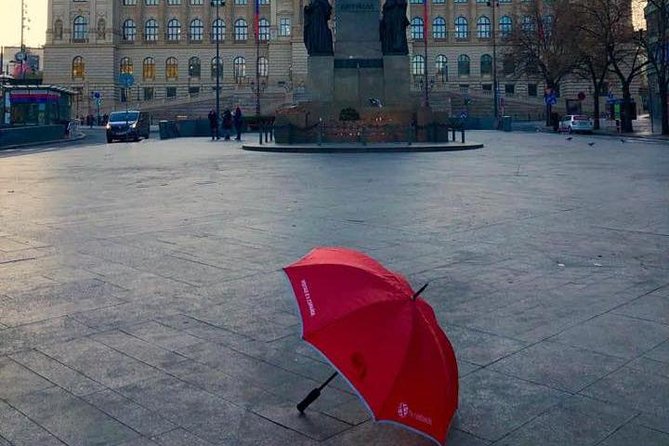
You start at Václavské nám. at 10:00 am and finish in Old Town Square in front of the Astronomical Clock, with a Charles Bridge photo stop along the way. It is family-friendly, runs with a small group capped at 25, and uses a mobile ticket, which is handy if you do not want to hunt for paper. One practical consideration: because you end in the busiest square in the city center, you will want a little buffer for photos and the changing street flow around closing time for day tours.
Key points to know before you go
- Spanish plus Czech bilingual guidance helps you follow the details without losing the vibe
- UNESCO World Heritage historic core route gives you fast context for first-time Prague
- Charles Bridge photo stop makes sure you actually get that iconic view
- Finish at the Astronomical Clock so you can linger at your own pace afterward
- Small group size (max 25) keeps questions realistic
- No entrance tickets included means you should plan for outside viewing unless you add extras
Prague in Spanish that actually helps you read the city
Prague is a “walk it to get it” place, and this tour is built for that. You are not racing from one stop to the next. Instead, you get a guided line through the center that helps you recognize the main styles and the major places, so the city starts making sense as you go.
The Spanish angle matters. When you are hearing the history and art ideas in a language you actually think in, you remember more. That is exactly what I look for in a city like Prague, where a 10-minute conversation can explain why one building looks Gothic while the next door looks Baroque.
A big plus is the way the guides handle questions and pace. In the reviews, people repeatedly single out guides such as Nelson Villarroel and Monica for being punctual, attentive, and genuinely fun while still covering lots of detail. You can tell they are comfortable talking about landmarks, not just reciting facts.
You can also read our reviews of more tours and experiences in Prague.

Start at Václavské nám., end at the Astronomical Clock
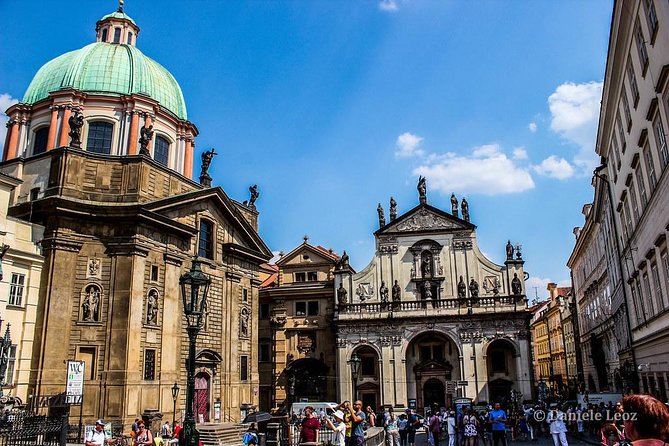
This tour has a clean start and a memorable finish, both in the heart of Prague 1. You meet near Václavské nám. 806/62, 110 00 Praha 1-Nové Město and set off at 10:00 am. You end at Old Town Square by the Astronomical Clock, so you can keep exploring after the tour without needing transportation.
That structure is more than convenience. Ending at the clock area is a smart way to avoid the most common first-time-tour problem: spending all your energy on getting oriented, then realizing you never get the classic photo at the end. Here, you finish where the photos and the atmosphere are thickest, so your last hour is more likely to feel like free time instead of hurried sightseeing.
Also, the route runs about 3 hours, which is a sweet spot. It is long enough to connect the landmarks, but short enough to keep your energy for later on the same day.
Wenceslas Square and the Municipal House, why modern Prague matters
The tour begins at Wenceslas Square, which is the kind of location that makes Prague feel like more than just castles and bridges. From here, you head toward the Municipal House, a standout landmark that represents a more modern side of the city. Even if you only see it from the outside, you get guided context for what you are looking at.
Why this matters: many first-time visitors arrive with a one-note expectation of Prague, usually medieval and romantic. Starting with the Municipal House helps you understand that Prague’s center is layered. Different eras sit side by side, and the city does not hide its 20th-century face.
If you are the type who loves architecture, this is a great “set the frame” moment. It helps you notice details later when the walk brings you to older Gothic and Baroque structures.
Powder Tower and Celetná Street to Old Town Square
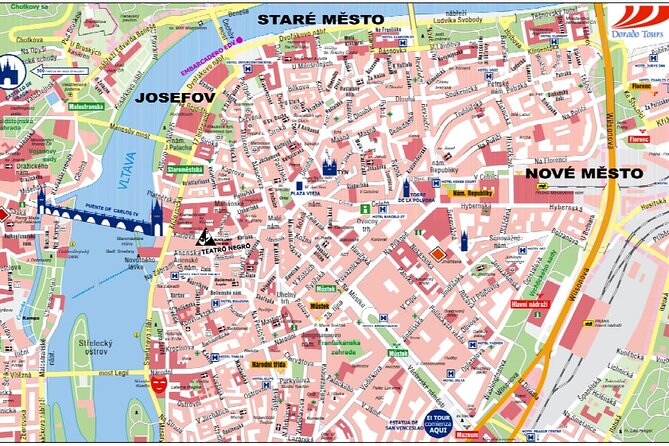
Next up, you move toward the historic core with the Powder Tower and Celetná Street in the mix. The Powder Tower is one of those places you might pass without realizing it is a major piece of the city’s old defensive and urban story. With a guide talking as you walk, it becomes a landmark with a reason to exist.
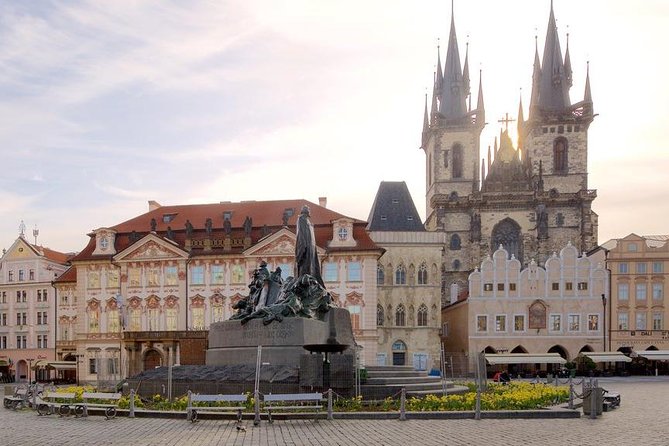
Then the route flows into Old Town Square, where Prague shows off like it knows you are watching. The square is a giant outdoor “style gallery.” Your guide points out the mix you see around the square, including Gothic features associated with Our Lady of Týn and the way later styles appear as you turn your head from facade to facade.
Practical tip: Old Town Square is where attention tends to drift because everything looks important. Let the guide bring you to the key viewpoints first. Once you understand what you are looking for, you get a much better second pass on your own after the tour.
Our Lady of Týn and Saint Nicholas, the church stops you will remember
Old Town Square is not only pretty, it is instructive. Two church highlights shape the experience here:
- Our Lady of Týn: tied to the Gothic look of the square.
- Saint Nicholas: often described as a must-see for its strong baroque feel.
These stops are valuable because they give you something to anchor to. When you later see other church spires and domes around town, you have a reference point for how Prague switches moods through architecture.
This is one of the most praised parts of the experience for a reason. Reviews praise guides for being able to explain history and culture in a way that feels organized, not like a lecture. The church stops are where that strength really shows, because you can actually see what the guide is pointing at.
If you care about art and details, wear shoes you can stand in for a while. You will likely pause more than once for photos and explanations.
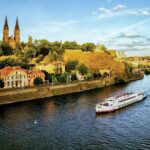
Franz Kafka Square and the Clementinum, learning in Jesuit form
A key cultural stop comes near Franz Kafka Square and Marianské Square, with the Clementinum in the mix. The Clementinum is described as having been built as a Jesuit university, and that simple detail helps you understand why the buildings feel educational, orderly, and central rather than purely ceremonial.
This is a nice change of pace from the biggest open-sky areas like Old Town Square. It gives your brain a different kind of map. You start seeing Prague not just as scenic postcards, but as a functioning city with institutions, learning centers, and long-term influence.
And here is the benefit for you: once you connect a building to a purpose, it becomes easier to remember. That makes the whole walking loop stick in your head long after you leave.
Karlova Street, the path toward Charles Bridge and the Jewish Quarter edge
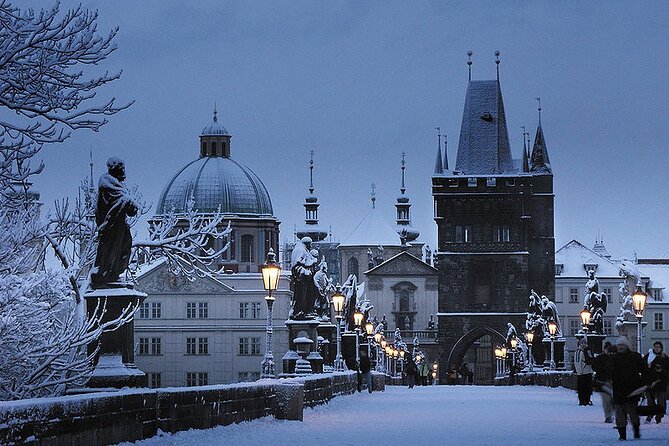
From the Clementinum area, the tour continues along Karlova Street and heads toward Charles Bridge. The tour includes a mandatory photo stop on the bridge, and it is for a good reason. Charles Bridge is one of the few places in Prague where the skyline views do the storytelling for you.
This photo stop is not just about capturing the famous angle. It also acts like a transition point. After the bridge, you move toward the Jewish Quarter area, and your guide’s narration can shift from general historic monuments to more focused neighborhood context.
Why this route works: many self-guided walks skip the “in-between” feeling. You see the bridge and then magically end up somewhere else. Here, you walk the connective tissue, so you understand how Old Town links toward the Jewish Quarter edge and back toward the center’s core.
Finishing at Old Town Square in front of the Astronomical Clock
The tour ends at Old Town Square in front of the Astronomical Clock. This is a smart finish for two reasons.
First, it gives you time to enjoy the area after the guide. A guided walk can help you learn fast, but you still need a few minutes of unstructured wandering to absorb the atmosphere.
Second, you can choose what to do next based on your energy and interest level. The clock area stays central, so it is easy to continue on foot to nearby sights, cafes, or viewpoints.
One practical note: the end area can get crowded. Have patience for the flow of people, and plan your photos calmly. If you want a clear shot, let the guide point you to a good angle first, then follow your own instinct for a second attempt.
Price and logistics: is $18.44 a fair deal for a Spanish guided walk?
At about $18.44 per person for roughly 3 hours, this tour is good value if you want a structured overview without paying museum-style entrance fees. The big thing you are buying is interpretation: you get a Spanish guide who can explain what you see across multiple stops.
You also get a mobile ticket, which reduces hassle. And with a max group size of 25, you are less likely to feel like you are part of a human conveyor belt.
The trade-off, to be clear: entrance tickets are not included. So if your dream day includes lots of interior visits, you may need to add those separately. That does not make the tour bad. It just means you are using it as the orientation layer, then layering extra visits where you want them.
For me, the best way to judge value is to ask: do you want a guided “get oriented fast” experience in Spanish? If yes, the price makes sense.
How the guides shape the experience, Nelson, Monica, and more
The quality of this tour rests heavily on the guides, and the reviews show a clear pattern. People mention Nelson Villarroel as an attentive guide who makes the visit fun and answers questions while showing the group many memorable corners. Another recurring name is Monica, praised for being exceptional, respectful, punctual, and strong on historical, cultural, and art details.
That kind of feedback matters because Prague is full of complicated visuals. The difference between seeing buildings and understanding buildings is often how the guide frames them. When a guide is patient and responsive, you end up caring more about small details, not just big monuments.
Also worth noting: the tour is described as having native bilingual guides in Spanish and Czech. That pairing usually means clearer explanations and fewer language gaps when questions get specific.
What to do if you want more than outside views
Because entrance tickets are not included, you should treat this as an outside-and-street-smart tour. You will still get the meaning behind monuments, but you are not automatically stepping into every site.
If you plan ahead, you can make this work beautifully:
- Use the tour to learn which buildings matter most to you
- Then, after the tour, add any interior visits on your own, only where you actually want them
This approach saves money compared to booking a bunch of separate tickets for every stop. It also stops you from feeling locked into a rigid plan when you realize one site is not for you.
Who this tour is best for (and who should think twice)
This tour is a strong match if:
- You want a Prague walking tour in Spanish with clear explanations
- You are visiting for the first time and want the historic core organized for you
- You like architecture and church stops around Old Town Square
- You are traveling with kids, since it is family-friendly and not overly formal
You might think twice if:
- Your main goal is interior visits and paid entrances. The tour is not built around included admissions.
- You prefer a very slow, do-everything-at-your-own-pace day. This is a structured 3-hour walk.
Should you book this Spanish Prague walking tour?
I think it is a smart booking for most first-time visitors, especially if you want your orientation in Spanish. The combination of UNESCO core coverage, a Charles Bridge photo stop, and a finish at the Astronomical Clock gives you a complete, memorable circuit in only about 3 hours.
Book it if you want to understand what you see, not just check photos. Skip it only if you are planning a day focused almost entirely on paid interior attractions, because entrance tickets are not included.
If you do book, wear comfortable shoes and be ready for a busy ending in Old Town Square. Then, once the tour finishes, use the clock area as your launchpad for your own next stops.
FAQ
What is the duration of the Prague walking tour in Spanish?
It runs for about 3 hours.
Where does the tour start and where do you end?
It starts at Václavské nám. 806/62, 110 00 Praha 1-Nové Město, and it ends at Old Town Square (Staroměstské nám.), in front of the astronomical clock.
What language is the tour offered in?
The tour includes an official bilingual guide in Spanish.
Are entrance tickets to monuments included?
No. Entrance tickets to buildings or monuments are not included.
Do I need to print a ticket?
No. The tour uses a mobile ticket.
Is free cancellation available?
Yes. You can cancel up to 24 hours in advance for a full refund.
More Tours in Prague

More Tour Reviews in Prague
Not for you? Here's more nearby things to do in Prague we have reviewed





Tours, compared.
 ★ 4.6Castle Tour with Local Guide and Entry TicketFrom $6110,422 reviews
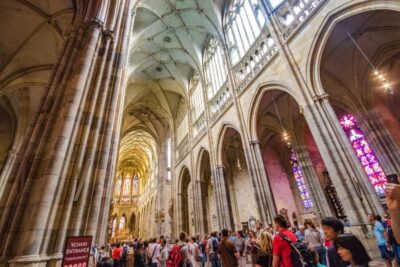 ★ 4.7Prague Castle 2.5-Hour Tour Including Admission TicketFrom $578,927 reviews
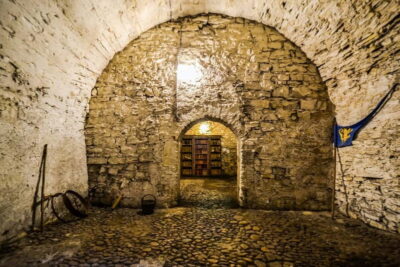 ★ 4.2Oldtown, Medieval Underground & Dungeon History TourFrom $308,244 reviews
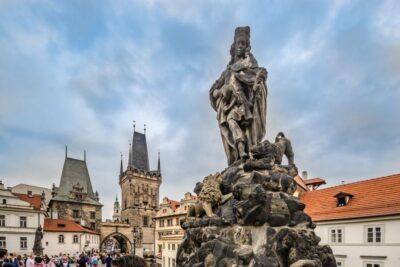 ★ 4.73-Hour Walking Tour of Old Town & Prague CastleFrom $305,696 reviews
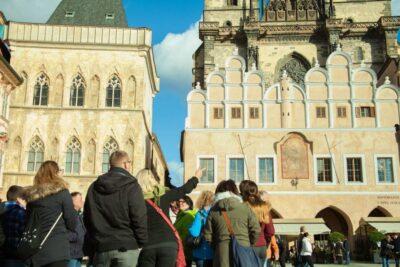 ★ 4.83-Hour Old Town and Prague Castle Tour in GermanFrom $365,671 reviews
 ★ 4.4Ghost Walking Tour Where Legends Come To LifeFrom $275,253 reviews
 ★ 4.3Ghosts, Legends, Medieval Underground & Dungeon TourFrom $315,104 reviews
 ★ 4.5Klementinum Library & Astronomical Tower Guided TourFrom $185,050 reviews