
REVIEW · PRAGUE WALKING TOURS
Walking tour of Prague in French : Nové Město
New Town Prague runs on a medieval blueprint. This French walking tour in Nové Město connects Charles IV’s 14th-century plan to the city’s most photogenic streets, squares, and river views. I especially love the way you get architectural variety in one compact route, and how the walk naturally funnels you to the Vltava quays and Archer’s Island for great photos.
One thing to consider: it is mostly outdoors, so comfortable shoes and a rain plan matter, because you’ll walk in rain, shine, or snow.
The guide on this tour, Alexandre, keeps the history clear and human, not like a textbook. You’ll see how the district was designed around three market centers, and you’ll connect that idea to what you actually stand in front of today. The pacing is steady, with short stops, so bring your curiosity and expect a brisk, city-watching rhythm.
Key highlights you will feel on the ground
- Medieval urban planning you can map in your head, built around Charles Square, Wenceslas Square, and Senovážné Square
- Photo-friendly river time along the Vltava quays, including Archer’s Island viewpoints
- Big-name landmarks in a logical route: Powder Tower area, Municipal House, Estates Theatre stories, and more
- A mix of styles on purpose: Gothic, Baroque, Art Nouveau, and even Cubist touches as you walk
- Cultural identity moments tied to the Czech National Renaissance, including the National Museum and National Theatre
Why Nové Město feels planned, not random
Nové Město is Prague with its paperwork still visible. In 1348, Charles IV laid out a district that was meant to function. The trick is that it was designed around three central market areas, and you still feel that logic when you walk from square to square.
Here’s what makes it more than trivia: those markets shaped movement and commerce. Streets, major buildings, and civic life clustered around them. So when you stand in the right place, history stops being abstract. It becomes a map of how people once lived, shopped, and gathered.
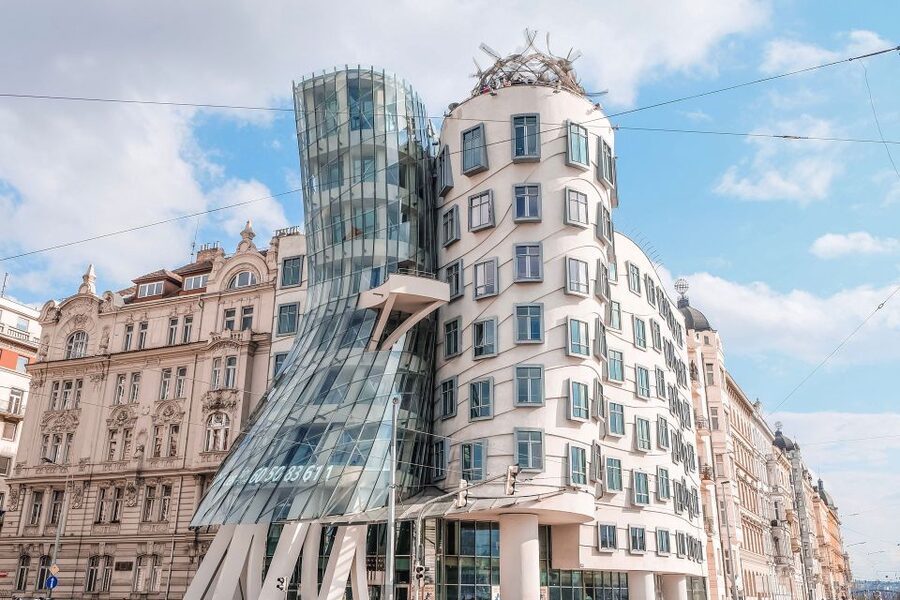
You also get a second layer: Nové Město is not frozen in the Middle Ages. As Prague changed, new architecture arrived. That’s why one moment can feel Gothic and old, and the next can feel modern, including references to events like the Prague Spring and contemporary landmarks such as the House Who Dances (Karásek’s famous building).
You can also read our reviews of more walking tours in Prague

Price and what you get in French with a licensed guide
At about $27 per person for roughly 2.5 hours, you are paying for two things that matter in this kind of walk: language access and interpretation. This isn’t just sightseeing. You get a local guide licensed by the Czech Ministry of Tourism, and you walk in French with explanations about Czech culture and the sites you pass.
Value check: you also get practical direction built into the tour. The experience includes good addresses in the area and advice for your stay, which can save you time later. Since food and transport are not included, that guidance helps you spend your money where it counts, instead of guessing.
The other “value” piece is pacing. Each stop is short, but the tour stitches them into a story. If you like to leave Prague with a better sense of what you’re seeing, this format usually works well.
Starting at Jindřišská věž, then learning the lay of the land
You meet in front of the entrance of Jindřišská Tower. Even if you don’t stare at the tower the whole time, it helps you orient fast. From there, you slide into the rhythm of Nové Město: planned streets, civic spaces, and big facades that reveal different eras.
Expect early moments of orientation. The guide sets you up to understand that Nové Město was not built as a single style or single decade. It was a working district designed for activity, then reshaped over centuries. That framing makes everything that follows easier to read as you walk.
Senovážné náměstí to Na Příkopě: the market story begins
Your first named stop is Senovážné náměstí. This square matters because it is one of the three planned centralities from Charles IV’s blueprint. Think “hay market” here, and you start learning how the whole district was organized around trade and daily needs.
From there, you move toward Na Příkopě 864, then on to Náměstí Republiky. This stretch is where Prague’s architectural variety becomes obvious. You’ll notice how different styles coexist and how facades can signal different periods without turning the whole area into a museum.
A small practical note: this part is good for street-level watching. Look up. Prague rewards it. Also, if it’s wet out, take a careful pace on uneven sidewalks and keep an umbrella secured, because you’ll be moving from stop to stop.
Náměstí Republiky and Ovocný trh: where major styles show up close
At Náměstí Republiky, the feel turns civic and monumental. This is the kind of square where Prague’s identity shows in stone and design choices. It’s also a common area for major sights, and your guide uses it to connect the district’s growth to landmarks you’ll recognize.
Next comes Ovocný trh. The name alone hints at old commerce and daily life, and the area works well for understanding how Nové Město was meant to be lived in, not just visited. Even if you don’t count every detail, you’ll get the big idea: this district was built to move people through it.
You’ll also hear stories tying together the Czech National Renaissance and later events. That matters here because Nové Město is where national culture ambitions became visible in architecture and public institutions.


Václavské náměstí and Jungmann Square: the horses market and a culture shift
When you reach Václavské nám. 826, you are stepping into Prague’s grander urban stage. This is the neighborhood’s scale-up moment, where streets broaden and landmarks start feeling more “center stage.”
Then you visit Jungmann Square. It’s a helpful pause, because it gives you a reset in the middle of a longer stretch. You can catch your breath, look for facades, and let the guide connect older planning to more modern building eras.
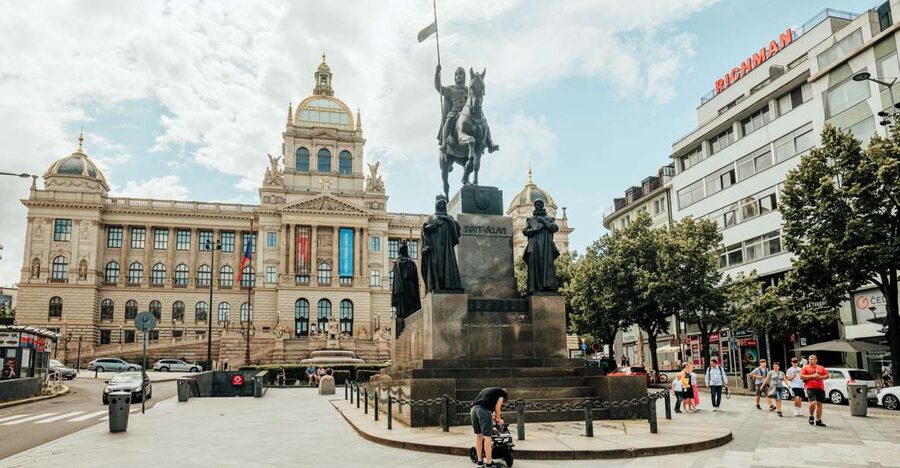
And then comes the key square: Wenceslas Square. This is the “horses market” centrality from the medieval plan. Knowing that turns the square into more than a famous address. You understand why it became such an important corridor for public life.
Wenceslas Square also connects to the cultural story of Prague. This is where you start hearing how the National Museum and the National Theatre fit into the Czech National Renaissance, a movement tied to identity building and the lead-up to independence in 1918.
Franciscan Gardens and the David Černý sculpture: a breather with personality
You head to Franciscan Gardens. This is a change of mood. It’s a place where you get a calmer feeling, and the tour becomes less about big public buildings and more about how Prague spaces can shift from formal to quiet within minutes.
From there, you get a quick stop at David Černý’s sculpture, Kun. Even if you are not chasing “street art” in the usual sense, this kind of stop adds a modern layer to your understanding of Prague. The guide uses it as proof that Nové Město is still a living city, not just a historical set.
It’s also one of those short stops that works for photos, especially if the light is good and people are moving around you.
Down to Charles Square and Resslova: the cattle market and the theater connections
Next you walk toward Charles Square, which is the “cattle market” centrality. When you stand there with the context in your head, it’s easier to see why certain buildings and institutions matter in the district’s story. Trade hubs shape urban importance, and Charles Square became one of the anchors.
You then pass through Resslova, another spot where the guide keeps tying the layers together. This is where architecture style mix becomes a theme: Gothic and Baroque influences show up alongside later movements, including Art Nouveau and Cubist-era touches that you can spot on streets rather than only in major museums.
The tour also brings in landmark stories around major cultural buildings. You may hear about the Powder Tower and the Estates Theatre as part of the district’s larger architectural narrative, as well as the Municipal House and the House of the Black Madonna within the broader walk through Nové Město’s notable facades.
Masarykovo nábřeží to the National Theatre: the city turns toward the river
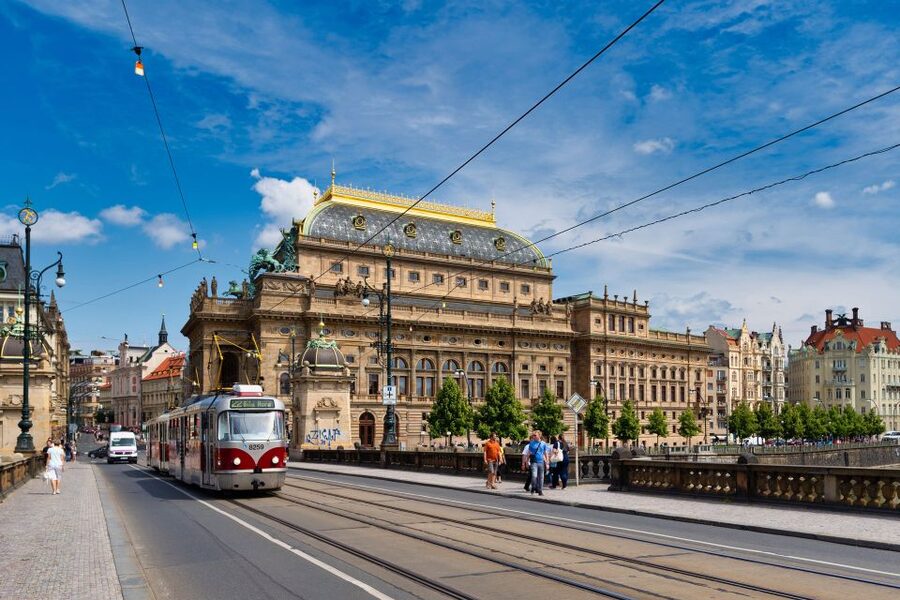
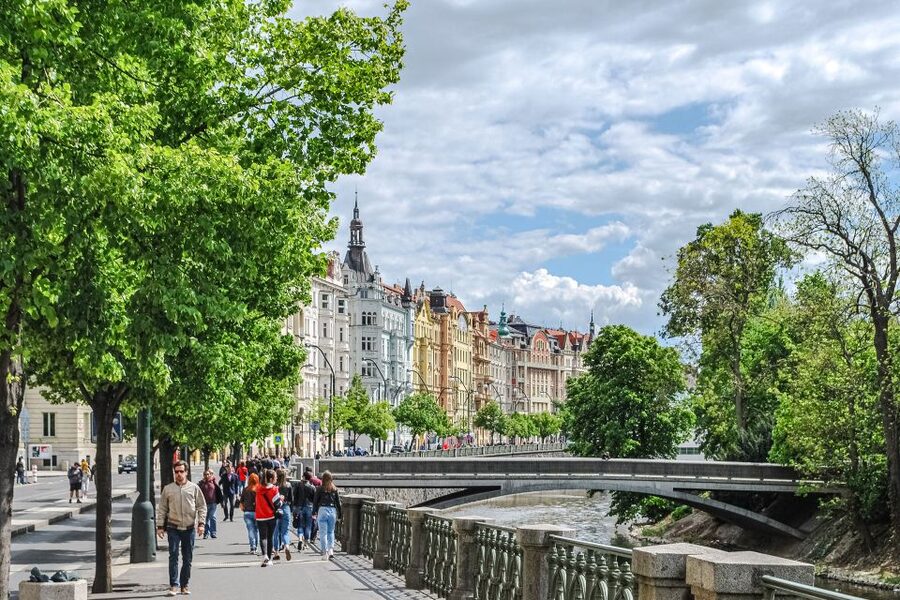
Then you start transitioning from squares into river energy. Masarykovo nábřeží is your quick step toward the Vltava, and by the time you reach the Prague National Theatre, you understand why Prague’s river matters so much. This area is about presence. The buildings feel like they belong to a bigger visual stage.
The guide uses the National Theatre stop to talk about the Czech National Renaissance again, which is especially useful if you’ve been hearing Prague stories from many angles. It ties cultural ambition to place, not just to dates.
Also, keep your phone ready here. Even without professional gear, the views can look good fast because the river gives you natural depth and reflections when the light cooperates.
Legion Bridge, Archer’s Island, and Park Legií: your best photo stretch
You cross by Legion Bridge, which is where your camera time starts to make sense. This is not random wandering. You are getting the exact orientation needed for the later viewpoints.
Then you head to Park Legií, and this is where the walk earns its highlight billing. The park gives you perspective over the river and the surrounding river walk areas, including viewpoints linked with Archer’s Island (Střelecký ostrov). If you like “one good photo that explains the city,” this is that segment.
This is also where the tour’s best advantage shows: you are walking at human speed, stopping often enough to absorb details, but not so long that the story drifts away. The river part feels like a payoff, not a filler.
A few tips to make the tour easier and more rewarding
If you want to get more out of the 2.5 hours, here are the practical things that help:
- Wear comfortable shoes. You have many short segments, and you’ll be moving a lot.
- Bring layers. The tour runs rain, shine, or snow, so weather changes will happen.
- Look up often. Nové Město rewards you for checking facades and not only scanning street signs.
- Have your curiosity turned on. The best moments come when the guide connects medieval market planning to the buildings you see now.
- Keep time for photos at the river. If you try to rush this part, you’ll miss the easiest shots.
Should you book this Nové Město walking tour?
If your goal is to understand Prague’s New Town in a way that sticks, this tour is a strong booking. It’s short enough to fit easily into a day, but detailed enough to give you context for the architecture and the city’s cultural milestones. French language delivery and a licensed local guide also make it a safe choice for anyone who wants structure without feeling like a lecture.
I’d skip it only if you hate outdoor walking, or if you prefer long museum-style stops rather than a moving route with lots of small points of interest.
If you want the story behind the squares, plus a real river-view photo payoff, this one is a smart way to spend your time in Prague.
FAQ
How long is the walking tour in Nové Město?
It lasts about 2.5 hours.
What language is the guided tour in?
The tour is in French.
Where do I meet the guide?
Meet in front of the entrance of Jindřišská Tower.
What is the tour route like at the end?
The activity finishes back at the meeting point, with the itinerary listing Park Legií as the finish area.
Is the tour held in good weather only?
No. It runs in rain, shine, or snow.
What is included in the price?
A local guide licensed by the Czech Ministry of Tourism, the walking tour of about 2.5 hours in French, explanations of the visited sites and Prague history and Czech culture, plus good addresses and advice for your stay.
What is not included?
Pick-up and return to the hotel, transport tickets, and food and drinks are not included.
More Walking Tours in Prague
More Tours in Prague
More Tour Reviews in Prague
Not for you? Here's more nearby things to do in Prague we have reviewed







Prague Walking Tours, compared.
 ★ 4.73-Hour Walking Tour of Old Town & Prague CastleFrom $305,696 reviews
 ★ 4.4Ghost Walking Tour Where Legends Come To LifeFrom $275,253 reviews
 ★ 4.7Jewish Quarter Walking Tour with Admission TicketsFrom $763,729 reviews
 ★ 5.0Prague Guided Walking Tour and Cruise with Authentic Czech LunchFrom $1023,627 reviews
 ★ 4.6Old Town and Jewish Quarter Guided Walking TourFrom $222,847 reviews
 ★ 4.5Prague Ghost and Legend of Old Town Walking TourFrom $212,630 reviews
 ★ 5.0Prague 3-hour Afternoon Walking Tour including Prague CastleFrom $531,899 reviews
 ★ 4.7Ghosts and Legends Nighttime Guided Walking TourFrom $221,462 reviews
Browse the lists this tour appears in