
REVIEW · PRAGUE CASTLE TOURS
Prague Castle St. Vitus Cathedral, Royal Palace, St. George’s Basilica
Prague Castle feels different when a historian guides your steps. In this German 3-hour tour with Mr. Robert Procházka, you cover the big-ticket interiors and the quieter storytelling stops, from St. Vitus Cathedral to Golden Lane.
What I like most is how the route links architecture to real power, faith, and drama, not just stone and dates. I also love the Golden Lane part, because the alchemists and Kafka connection make the castle feel human again.
The one thing to think about is the language: the tour is German only, so if you do not follow German comfortably, you might find it harder to catch the details. Also, it is not suitable for children under 10.
Key things to know before you go
- Historian-led in German with Robert Procházka, which keeps the facts grounded and the stories coherent
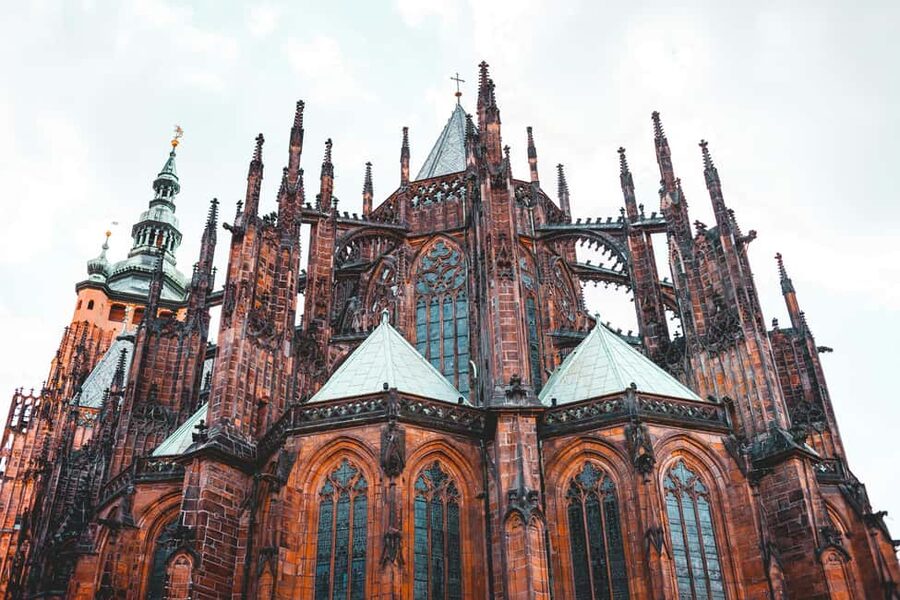
- St. Vitus Cathedral focuses on coronations, royal burials, and Gothic design you can actually see and picture
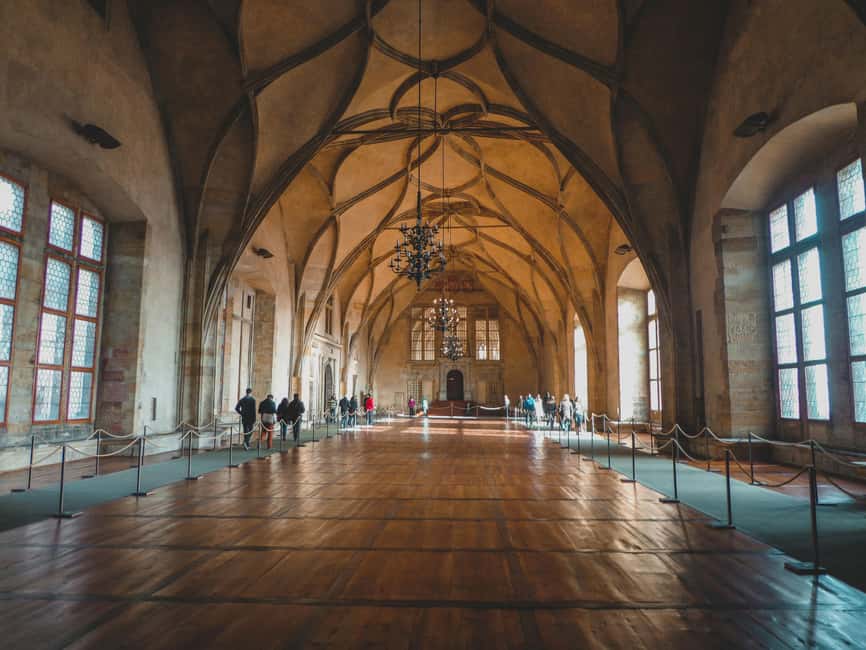
- Royal Palace highlights include a replica of the Bohemian crown jewels and the big late Gothic throne room
- St. George’s Basilica centers on St. Ludmila’s tomb and why it matters in Bohemia
- Golden Lane scenes bring you to the 16th-century world of Rudolf II’s alchemists and Kafka’s living space
- Prague-wide views from the castle grounds help you connect each stop to the city below
Meeting at Prague Castle, and why that matters
This tour starts right at the streetcar stop Pražský hrad (Prague Castle), streetcar lines 22 or 23 heading direction Bílá hora. That location is a big deal because Prague Castle is spread out. Starting at the right stop means you begin in the core zone instead of wasting time on guesswork or transfers.
You do not just drift around either. The experience runs for about 3 hours, and it ends back in the same area near the Golden Lane, returning you toward the castle grounds rather than dropping you miles away.
And since it is a historian tour, you will spend less time trying to interpret everything yourself. You still get to look. The guide just helps you look in the right order, with the right context.
You can also read our reviews of more tours and experiences in Prague.


The castle grounds first, with views that do the heavy lifting
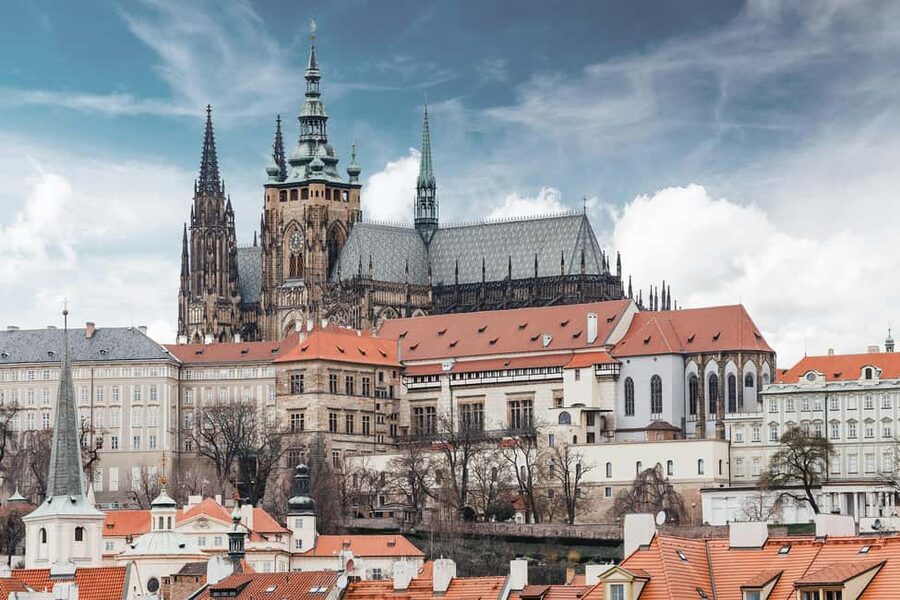
Even before you get deep into the buildings, you get the sense that Prague Castle is on another scale. The grounds are listed in the Guinness Book as the largest enclosed castle grounds in the world. That sentence sounds like trivia, but it changes how you experience the space. You feel how the site works as a fortified power center, not just a pretty backdrop.
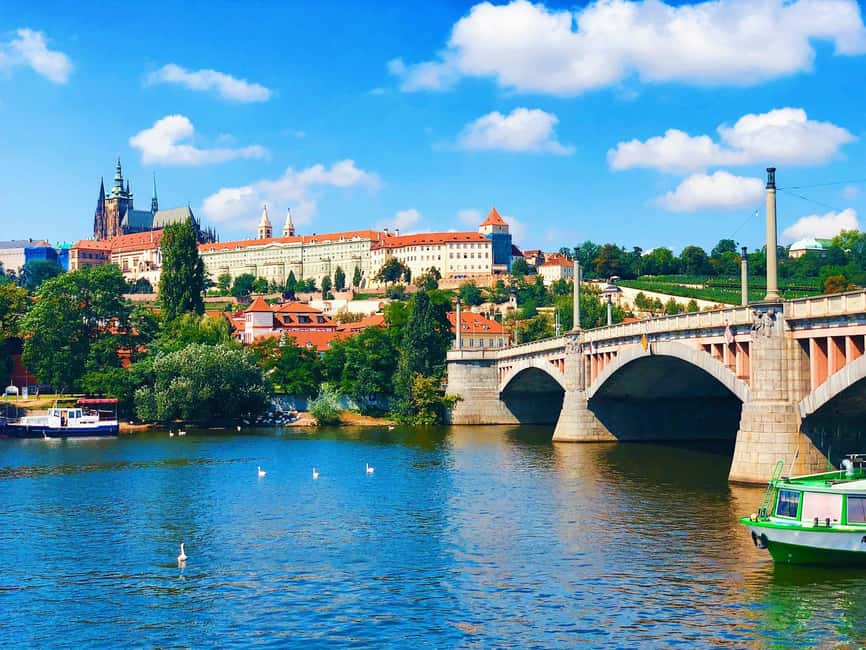
And the views help. You get a chance to see the spread of Prague from the castle area, which makes the architecture and rooftops snap into perspective. It is the kind of view that makes you understand why rulers and church leaders wanted to be here in the first place.
If you are short on time in Prague, this view angle gives you a map in your head. You can better connect what you are walking through now with what you will see later around the river.
St. Vitus Cathedral: coronations, burials, and Gothic drama you can spot
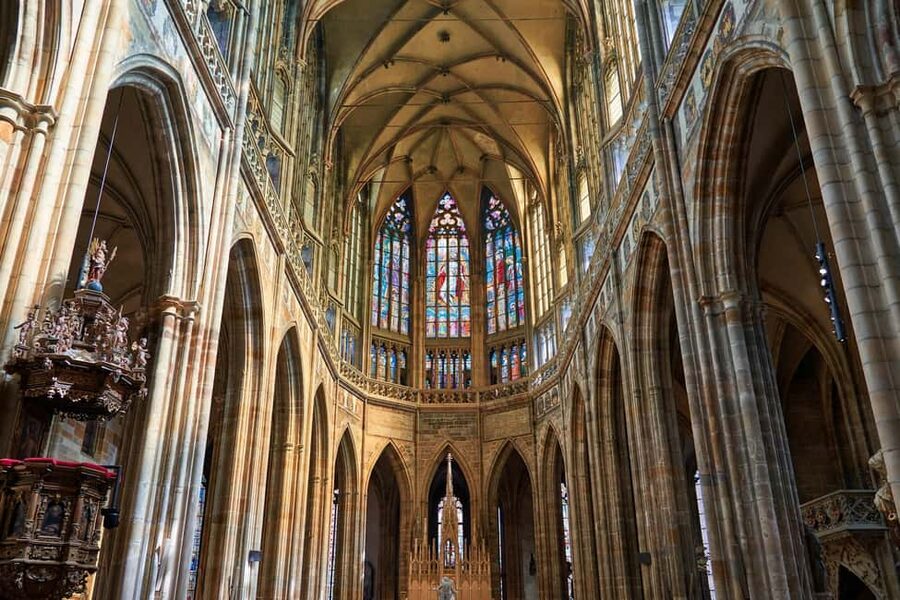
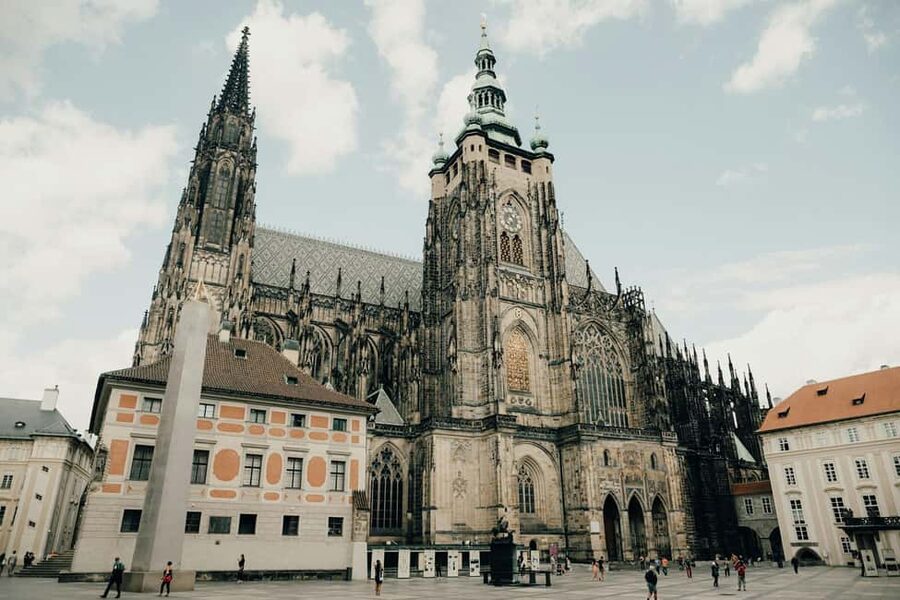
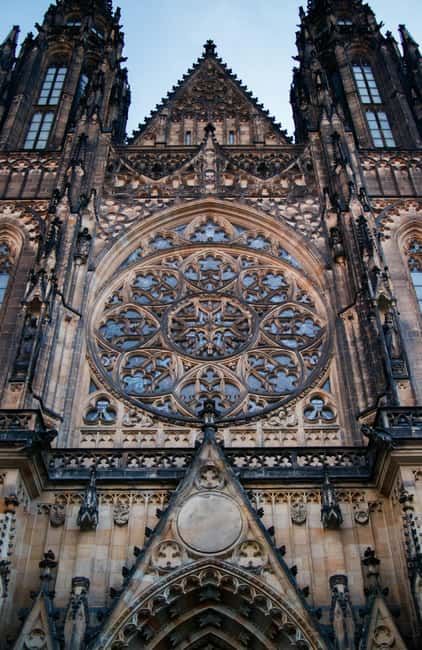
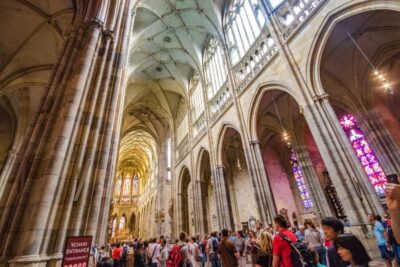
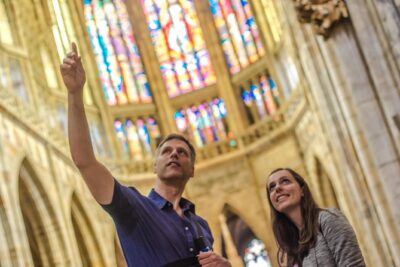
St. Vitus Cathedral is the emotional center of this tour, and the guide keeps it focused. This is the burial and coronation site of Bohemian kings, so the space is not only about beauty. It is about legitimacy.
You start with the cathedral’s long timeline. The oldest predecessor building, a Romanesque rotunda, was founded around 925. Then the cathedral becomes a masterpiece of 14th-century Gothic architecture. When you hear that shift in periods, it becomes easier to read the building while you are standing inside. You are not looking at one style, you are seeing a city and a kingdom changing over time.
You also learn who is connected here. Important patron saints of the country, including St. Wenceslas and St. Adalbert, are buried in the cathedral. That matters because it explains why the guide spends time on specific chapels and storage spaces, rather than treating everything as equal.
One of the most vivid details is the spiral staircase route linked to the Wenceslas Chapel, decorated with semi-precious stones. From there, the tour connects to the crown chamber, where the coronation regalia are kept. Even if you do not consider yourself a “cathedral person,” this kind of guided path helps you understand how religious power was staged physically inside the building.
Practical note: there are interiors and then more interiors. If you tire easily from standing and walking in a single long stretch, take your time, and pause whenever the guide stops to point things out. The “value” of the tour is that you do not miss the key elements.
The old Royal Palace: power rooms, crown symbolism, and a historical spark
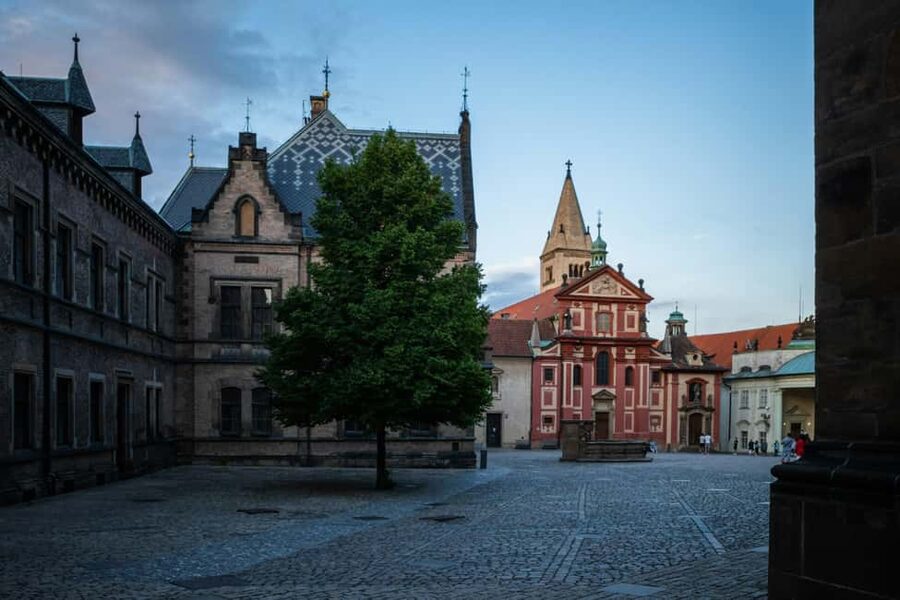
Next comes the old Royal Palace, and this part is strong if you like history that has consequences, not just costumes.
You will see a replica of the Bohemian crown jewels, which is a useful framing tool. Even as a replica, it makes you understand that objects were not just ceremonial. They were arguments about who had the right to rule.
Then the tour moves you into the largest late Gothic throne room in Central Europe. That scale is not random. It is built to work for authority, speeches, rituals, and state theater.
The guide also connects the palace to a specific flashpoint: the site of the Third Defenestration of Prague, at the State Chancellery, which helped start the Thirty Years’ War. You might look at that room and wonder how an event like that actually happened. The historian focus helps you connect the location to the bigger political chain reaction, instead of leaving the story as a vague “big war began here” line.
What I appreciate is that this section does not only chase dramatic events. It ties drama back to architecture and the functions of rooms. You learn to think like the place was designed for power, not for comfort.
St. George’s Basilica: where personal tragedy meets national memory
The stop at St. George’s Basilica shifts the mood. This church is from the 10th century, and it centers on a very specific figure: the tomb of St. Ludmila, grandmother of St. Wenceslas.
The story is hard, but it is part of why the basilica matters. The basilica tradition ties Ludmila’s death to violence carried out by Viking warriors, reportedly on behalf of her daughter-in-law. The guide keeps the focus on why this tomb became a point of remembrance in Bohemia.
This stop can be a relief if you are feeling overwhelmed by the scale of St. Vitus and the palace rooms. Instead of kings and ceremonies, you get a personal, tragic storyline that makes the religious site feel less distant.
If you like “why this matters” context, this is one of the best parts of the tour, because it turns an otherwise quiet interior into a meaningful story.
Golden Lane: Rudolf II’s alchemists, Kafka’s house, and a street you can walk
Then you reach the Golden Lane, the 16th-century lane that brings a more everyday, almost storybook atmosphere to the castle grounds.
Emperor Rudolf II’s alchemists are part of the main focus. They searched for an elixir of life and tried to produce gold from lead. That sounds like fantasy, but in a guided setting it becomes a window into the era’s hopes, experiments, and obsession with transformation.
And then comes the literary hook: Franz Kafka lived in one of the little houses in Golden Lane. Again, you are not just hearing trivia. You are walking through a space where those ideas and lives overlap with the castle’s official power world.
The Golden Lane section is also where you get a break from the bigger, heavier buildings. The lane scale makes the stories feel close. It is easier to imagine what life might have been like in a cramped, cobblestoned pocket inside such a massive complex.
The tour ends here, with the route structured so you finish in the place that feels the most like a small neighborhood inside a giant fortress. For many people, that is the perfect ending.
What the historian guide adds to your experience (and how to get the most)
This tour is led by Mr. Robert Procházka, and the historian approach is the reason this experience gets high marks. You get explanations that are more connected than most sightseeing narration.
You can hear architecture as a language instead of random features. You can connect chapels to rulers, palace rooms to political events, and Golden Lane to ideas and literature. That is the real advantage of doing these stops as one combined narrative.
To get maximum value, do two simple things:
- Watch for the guide’s transitions. They usually tell you what to look at next.
- If something catches your interest, stick around for a minute after the guide moves on. You will remember the story better once you let your eyes settle on the details.
One more point about the tour being German only: if you know basic German, you will still pick up names like Wenceslas, Ludmila, Rudolf II, and Kafka quickly. If you do not, consider whether you prefer a quiet tour you can still enjoy visually, or if you want your understanding to be full and detailed.
Price and value: $41 plus tickets, but minimal friction
The listed price is $41 per person, and it covers the 3-hour guided tour in German by the historian through castle grounds and interiors.
Entrance tickets are not included. Adults pay 18 EUR and seniors (from 65 years of age) pay 14 EUR, and the guide accompanies you to the ticket office so you can pay with a payment card or hand over EUR. The key practical advantage is that the tickets are purchased at a counter exclusively for guides, so you should not face the same kind of long public queues.
So is it good value? For me, it is when you care about meaning. If you want the cathedral, palace, basilica, and Golden Lane, trying to stitch together all of that on your own in the right order takes time, ticket handling, and lots of reading while standing in crowds. Here, you pay for the threading. The guide also helps you understand the connections between sites, which is often the missing piece when you self-tour.
If you only want one or two of the stops, you might do better with a lighter plan. But if you want the full “Prague Castle story,” this price is fairly sensible.
Who this tour suits best
This one fits best if you:
- Enjoy architecture plus context, not just photos
- Like clear, story-based history told in a steady pace
- Can follow German at least comfortably
- Want a fast but meaningful overview of the key castle interior sites
It may not be your best pick if you want a child-friendly format. The tour is not suitable for children under 10, and the content is built around cathedral, monarchy, and historical events.
Also, because you are walking and doing multiple interiors, it is not ideal if you are nursing mobility limits. The route likely stays within the main castle circuit, but it is still a 3-hour block.
Should you book this Prague Castle tour?
Yes, I would book it if you want the castle to make sense quickly. The combination of St. Vitus Cathedral, the Royal Palace, St. George’s Basilica, and Golden Lane covers the big layers of Prague Castle: sacred power, royal authority, personal tragedy, and the era of experiments and writers.
I would think twice only if German is a problem for you, or if you are the kind of traveler who prefers to wander without structure. In that case, a self-guided plan might feel more comfortable.
If you do book, arrive ready to look closely. The payoff is not just seeing famous places. It is understanding how those places connect, and leaving with a clearer mental map of Prague.
FAQ
What is the duration of the tour?
The tour lasts about 3 hours.
What language is the guided tour in?
The guided tour is in German.
Where is the meeting point?
You meet directly at the streetcar stop Pražský hrad (Prague Castle), streetcar lines 22 or 23 direction Bílá hora.
Which places are visited during the tour?
You visit St. Vitus Cathedral, the old Royal Palace, St. George’s Basilica, and the Golden Lane.
Are entrance tickets included in the price?
No. Entrance tickets are not included. Adults pay 18 EUR and seniors (from 65 years of age) pay 14 EUR, and the guide will accompany you to the ticket office where you can pay with a payment card or in EUR.
Is the tour suitable for children?
No. The tour is not suitable for children under 10 years of age.
More Tour Reviews in Prague
Not for you? Here's more nearby things to do in Prague we have reviewed





Prague Castle Tours, compared.
 ★ 4.7Prague Castle 2.5-Hour Tour Including Admission TicketFrom $578,927 reviews
 ★ 4.73-Hour Walking Tour of Old Town & Prague CastleFrom $305,696 reviews
 ★ 4.83-Hour Old Town and Prague Castle Tour in GermanFrom $365,671 reviews
 ★ 4.4Prague Castle and Lobkowicz Palace Entry TicketsFrom $385,066 reviews
 ★ 5.0Prague 3-hour Afternoon Walking Tour including Prague CastleFrom $531,899 reviews
 ★ 4.5Prague Castle Tour Including Admission Ticket – 2.5 HourFrom $591,171 reviews
 ★ 4.6Prague Castle: Midday Classical Concert at Lobkowicz PalaceFrom $281,106 reviews
 ★ 4.0Full-Day Prague Tour with Prague Castle, Lunch and Vltava CruiseFrom $75921 reviews
Browse the lists this tour appears in