REVIEW · PRAGUE
Prague Highlights in Half a Day
Prague, but focused and fast. This half-day walk mixes tailored commentary with big-photo stops like the 360 rooftop terrace, and it’s a great way to get beyond just one famous bridge. One thing to keep in mind: it runs best in good weather, and a couple of specific stops are marked as admission not included.
I like that the route feels like a story you can actually follow, starting at Wenceslas Square and ending with Prague Castle viewpoints that connect sights you might otherwise miss. The guide also matters here, and one named example is Nina, praised for taking people to landmarks they would not have found on their own. The other practical note: it’s priced per group (up to 15), so it’s a better value with friends or family than if you are a solo traveler shopping for the lowest cost.
Key points worth planning around
- A guide tailor-maps the walk to your preferences, right at the start
- Wenceslas Square gets political context like the Prague Spring and Velvet Revolution
- Lucerna Arcade can include a ride on the paternoster lift (on weekdays during working hours)
- A 360 degree rooftop stop at Máj House of Fun gives postcard views of Castle, Charles Bridge, and Old Town rooftops
- Old Town Hall, Jewish Town, and the Book Tunnel route pack key neighborhoods into one tight circuit
- Prague Castle viewpoints link the city’s icons including the Dancing House nickname Ginger and Fred
Before You Go: what a 3 to 4 hour highlights walk really feels like
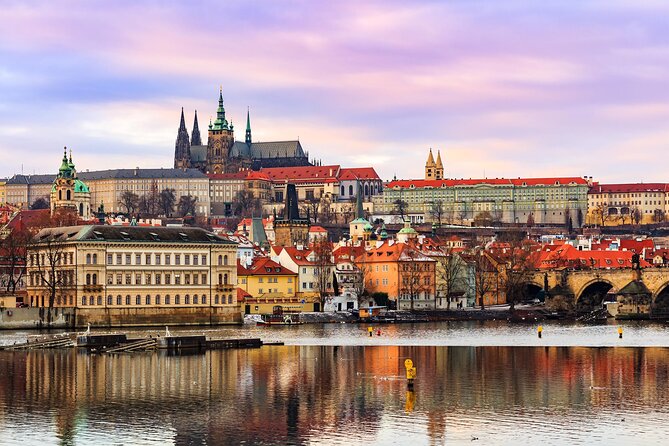
This is a 3 to 4 hour private tour for a group up to 15, offered in English, with a mobile ticket you can use on the day. You also get tickets for public transport included, which matters because Prague involves lots of moving between districts, even when the walk feels short on paper.
Expect a steady pace. The schedule is packed with quick stops, photo points, and short explanations, not long museum time. That structure is the main tradeoff of this format: you get many places, but you do not linger. If you like sitting and reading plaques for an hour, pick a slower option. If you like a sharp orientation to Prague, this works well.
Timing is also a factor. The stated opening hours run from 8:00 AM to 6:00 PM, and the experience notes good weather as a requirement. If Prague decides to rain on your parade, the plan can change or you can be offered a different date or a full refund.
You can also read our reviews of more tours and experiences in Prague.


Meeting on Wenceslas Square: get your bearings fast
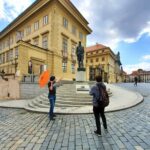
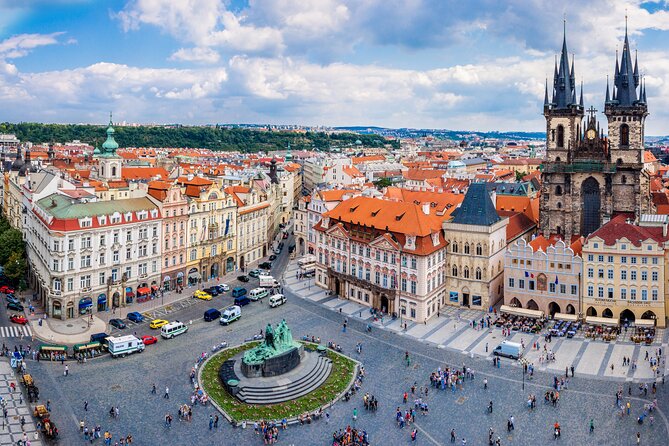
The tour meets at the Statue of Saint Wenceslas on Václavské náměstí, right by the Horse Statue top of Wenceslas Square, with the guide holding a sign with your name. Starting here is smart. Wenceslas Square is a natural “hub,” and the tour uses that location to set the tone for the entire day.
At the square, you are not only pointed at landmarks. You also get historical framing, including major events tied to the area like the Prague Spring and the Velvet Revolution. That kind of context changes how you see the buildings. Instead of treating it like a shopping street, you start to notice what people were reacting to, and why crowds mattered.
You should also be aware that this is a busy area. Even with a guide, it can be a bit chaotic around peak foot traffic, so wear shoes you can move in easily.
Wenceslas Square to Lucerna Arcade: architecture, art, and a real moving lift
From Wenceslas Square, the route moves to Lucerna Arcade. This stop is short, but it’s designed to help you spot details. You learn about the builder of the Palace, and you get to see an interesting sculpture by David Černý, one of the Czech Republic’s best-known contemporary artists.
There is also a bonus angle here. On weekdays during working hours, the tour notes you can try the paternoster lift. That’s the kind of old-school curiosity you might walk past without realizing it’s part of the building’s charm. If you are going on a weekday and the hours line up, this is one of the small “wow” moments.
One practical caution: Lucerna Arcade is listed as admission not included. That means you should assume this stop may involve extra costs depending on what the lift or any access requires at the time of your visit.
Quick facade stops: U Novaku, then Tesla’s stained glass
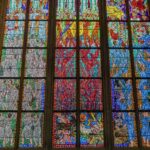
Next are two short, punchy stops. You’ll see the facade of the house U Novak and learn about the architectural style from that historical period. Then you’ll spot a stained glass window with a mosaic dedicated to Nikola Tesla.
These are brief stops on purpose. They function like puzzle pieces in the bigger picture of Prague. If you tend to think of Prague as “Old Town and Castle only,” these quick detours nudge you toward the city’s wider range.
Because the time here is tight, treat these as photo and explanation moments, not “I need time to read every plaque” moments.
The garden you did not expect, St. Nepomuk, and a cubism lamp
Mid-route, you’ll walk through a garden that you would not normally expect to find in the center of Prague. The highlight is a statue of a boy with a fountain of fresh drinking water. It sounds like a small detail, but it’s a very Prague kind of pause. You get a breather from streets, and you also get a sense of the city’s attention to everyday life.
After that comes the highest church in Prague with the largest altar, where the tour talks about the statue of St. Nepomuk standing in front of the church. This is one of those stops where your guide’s explanation is the product. The building and statues matter, but the real payoff is knowing what you are looking at and why it’s placed there.
Then there’s the cubism stop, including a lamp connected to cubism and the idea that this architecture type can only be seen in Bohemia. That line may sound sweeping, but it points you toward how Prague and the Czech lands have their own design DNA. Even a street lamp becomes part of the story.
Máj House of Fun rooftop: the 360 degree photo moment
If you love views and photos, this is the best single stop in the itinerary. At Máj – House of Fun Prague, you get access to the rooftop terrace above Fly Vista for 30 minutes. From the top, you get panoramic views that the route explicitly calls out, including Prague Castle, Charles Bridge, and the golden rooftops of Old Town.
This stop is listed as admission free, which is a big deal. Rooftops in Prague can cost money, so getting a meaningful viewpoint time without an extra ticket fee improves the overall value.
Art and design also show up here. The route notes you’ll see a finest example of Art Nouveau architecture in Prague, plus additional context about who is buried in the church and why. The mix works because you’re not stuck staring at a skyline. You’re also learning what you’re standing above.
A practical note: rooftop time is limited to 30 minutes, so plan to arrive ready. If you wait until the last minute to take photos, the tour will move on.
Old Town Hall, the Astronomical Clock, and legend spotting
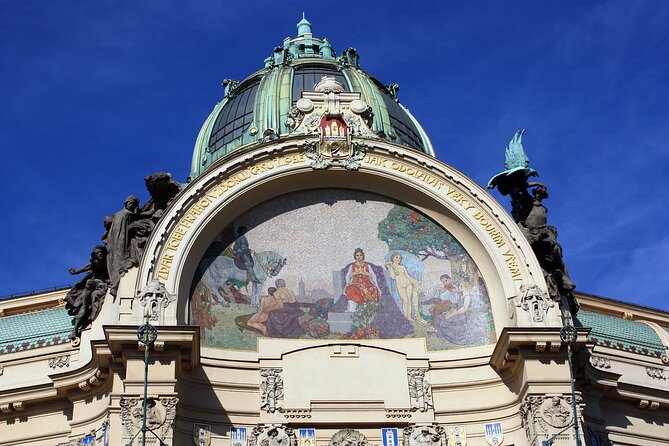
The Old Town Hall with the Astronomical Clock stop is another “short but important” element. The tour explains what you can actually see on the astronomical clock and what time period it dates from. It also covers the legend of the clock’s creator.
This is valuable because Prague’s most photographed clock can feel like a blur if you do not know what you are looking at. With a guide, the clock becomes more than a postcard background.
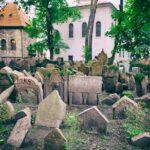
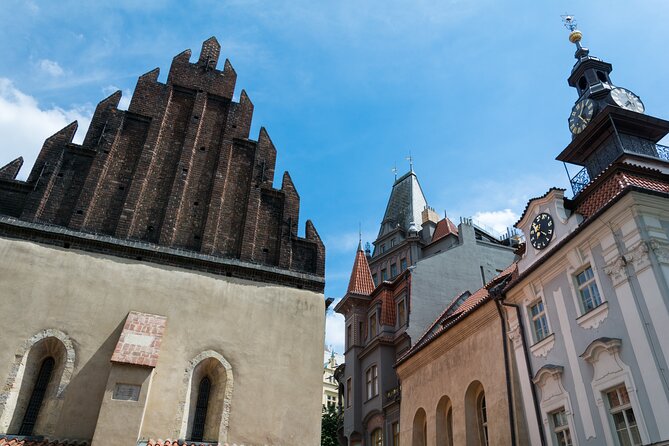
After that, you’ll see the gate through which the Old Town used to be accessible and learn how it was used. Then the walk heads into the Jewish Town area, with discussion of the history of Jews in Prague.
Book Tunnel and Kafka birthplace: the quiet-famous stops
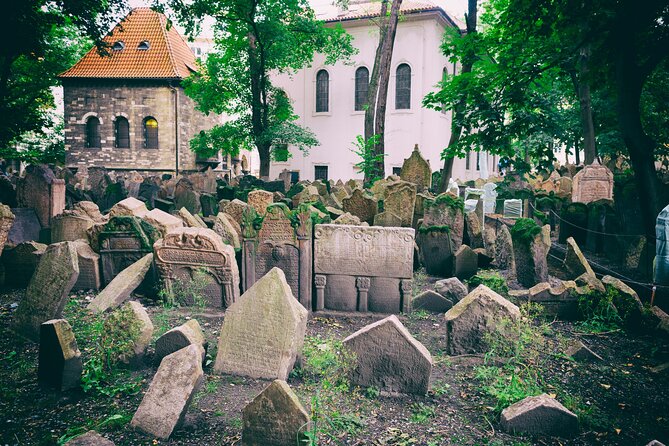
One of the internet-famous photo stops in Prague is the Column of books, sometimes called the Prague Book Tunnel or Column of Knowledge. The tour includes this as a dedicated viewing point. It’s a strong example of how this itinerary isn’t only about the headline monuments. It also includes the small, iconic corners people take photos of.
Next, you’ll see where Franz Kafka was born and get a talk about him. Kafka is one of those figures you either know already or you learn fast on site. Either way, a street-level context adds weight.
Across the oldest bridge, St. Nicholas churches, and Prague Baby Jesus
As you cross the oldest bridge in Prague, the tour discusses some of the sculptures along the route. That matters because it’s easy to cross a bridge without realizing you are moving through a gallery.
Then you’ll see both St. Nicholas Churches and learn about their builders and construction timing. That’s another stop where your guide’s explanation helps you separate appearances from facts.
Finally, you’ll learn where the Prague Baby Jesus is kept and hear the legend connected to it. This is exactly the kind of story that turns a religious artifact into something more human and memorable.
This portion of the itinerary leans toward legends and symbolism. If you prefer strict dates and documents only, you might find parts of this more story-driven than you want. Still, the stories are tied to real places, and that’s the point.
Waldstein Garden and Klementinum: a calmer shift before Castle
Waldstein Garden is another “you didn’t know it was here” moment. The route shows you where to enter and what you can find inside. It’s also listed as admission free, and the stop is only about five minutes, so think of it as a quick reset.
Then you’ll see where you can visit the beautiful library in Klementinum. Even without time inside, this cue is useful. If the library calls to you, you now know where to go next and what to look for.
Prague Castle: viewpoints, Royal Garden, Dvořák Hall, and the Dancing House
The itinerary includes Prague Castle as a major endpoint. You learn it is the largest fortified castle complex in the world, see what is hidden behind its walls, and then get a viewpoint from Prague Castle that includes the National Theatre building and Prague’s bridges.
That viewpoint is crucial. Prague Castle is not just a destination. It’s a machine for connecting the city together visually.
Next comes the Royal Garden. The tour notes the Royal Summerhouse and the Ball House, and it also says the garden is closed in wintertime, opening in April. The garden stop is short, but it helps you understand the castle area is not only stone and defense. It’s also planned space.
The route also points out the building that houses the Dvořák Hall, home of the Czech Philharmonic Orchestra, with a statue of Antonín Dvořák in front. You then see where the only privately owned building at Prague Castle is, owned by the Lobkowitz family, and you’ll be told why you should not miss the related museum on your full Prague trip.
From the viewpoints below Prague Castle, you get the connection shots too. You’ll be able to see the Dancing House nicknamed Ginger and Fred, designed by Vlado Milunič in collaboration with Frank Gehry. You’ll also see the house where Václav Havel lived.
Finally, the route mentions the TV tower with climbing babies visible from the Castle lookout. That makes the ending feel modern, even while you’re in the oldest fortress zone.
A practical consideration here is time. Prague Castle can swallow half a day if you let it. This itinerary keeps it manageable, so you get the most important viewpoint logic without getting lost in the full castle complex.
Price and value for up to 15 people
At $324.64 per group up to 15, this is priced for shared value. If you fill all spots, it works out to about $21 per person. Even if you are not a full group, you’re buying the guide time and the route planning across multiple neighborhoods.
Public transport tickets are included, which helps offset costs for getting between districts. The tour is also flexible in the sense that the guide tailors the itinerary to your exact preferences, rather than reading a rigid script.
Not everything is fully “no-cost.” Lucerna Arcade and the house U Novak are marked as admission not included. Most other stops are listed as admission free, including major sights like Old Town Hall with the Astronomical Clock, Prague Castle, Waldstein Garden, and the rooftop terrace.
If you are the type of traveler who wants the city explained, not just photographed, the math usually improves quickly.
Who this half-day highlights walk suits best
This works well for:
- First-timers who want a strong orientation fast
- Couples and small groups who prefer a private experience rather than a large coach crowd
- People who like architecture plus story, not only big museum hours
- Anyone who wants that Prague Castle viewpoint bundle without planning every crossing and stop
It might not be your best match if:
- You want long indoor time at major monuments
- You dislike walking in one continuous loop for a few hours
- You need guaranteed roof or outdoor time on the same day, since it’s weather dependent
Also, the tour notes that most travelers can participate and service animals are allowed. It is near public transportation, which helps if you need to hop out or return later.
Should you book this Prague highlights tour?
I’d book it if you want a guided, efficient “Prague beyond the famous bridge” kind of day, with built-in viewpoint payoff at Máj House of Fun and a finish at Prague Castle that connects major landmarks in one coherent loop. The best reason to go is the balance: quick stops with explanations, plus a couple of high-impact photo moments, all in a single 3 to 4 hour window.
Skip it if you already know Prague well and want deep time inside buildings, or if you are traveling during a period when rain is likely and you cannot shift plans. Otherwise, with English guidance, included transport tickets, and strong ratings (5 out of 5 from 56 reviews, recommended by 100%), it’s a dependable way to get more Prague per hour.