
REVIEW · PRAGUE CASTLE TOURS
Prague Castle Walking Tour
Prague Castle is easier to understand on foot. This small-group Prague Castle walking tour keeps the pace human, with a historian guide who explains how buildings and power changed over centuries. I like how you get clear architecture context on the hillside route, especially the shift from Romanesque to Gothic and beyond, so you are not just snapping photos. A possible drawback to plan for, the castle complex interiors need separate entry tickets you pay for yourself.
What also works well is the timing choice. You can select morning or afternoon, and I like that the afternoon option often means easier crowds inside the complex. Just remember, not all stops are included in the ticket price, and there are no food and drinks provided, so build in time for breaks if you need them.
Key highlights that make this tour worth your time
- Small group size (max 8 people) means you can actually hear your guide.
- Historian guide focus on architecture styles ties what you see to what happened in Prague.
- A 3-hour route on Hradčany Hill covers major castle and Royal District landmarks without feeling rushed.
- Royal Garden stops include the Ball Game Hall and Queen Anne’s Summer Palace and their surprising stories.
- Golden Lane and the royal maze of meanings connect Rudolf II, guards, and even a dungeon tower link.
- A stop after the castle helps you keep the day coherent with Hradčany sights like Domeček and Strahov Monastery.
The quick picture: what a 3-hour Prague Castle walk covers
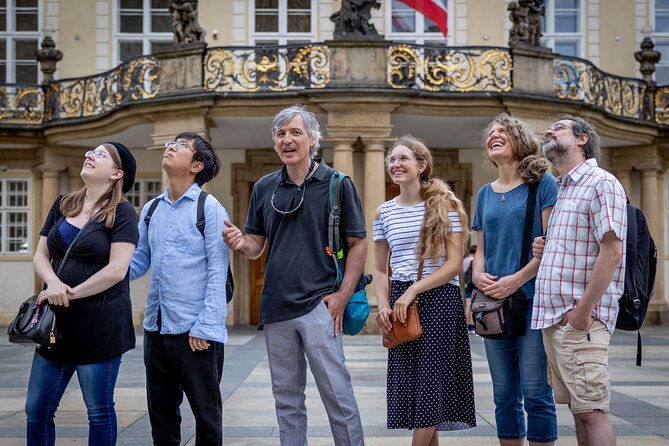
This is a focused 3-hour small-group walking tour in Prague, with a maximum group size of 8 people and a historian guide. You meet in Malá Strana, then climb up to Prague Castle on Hradčany Hill, taking in the Royal District along the way. The tour is offered in English, and you choose either morning or afternoon timing.
The big idea here is interpretation. Prague Castle is huge, and it is easy to walk around feeling like you are collecting buildings, not understanding the place. This tour is designed to help you see the same stones in a new way by pointing out the architectural transitions, the political drama, and the religious power that shaped the complex.
Price matters too. At $126.16 per person, you are paying for the guide and the structured route, not just entry into one site. Since the main castle entrance and several interior admissions are not included, the total cost will go up for most adults. Still, for people who want a guided path through a complicated site without a crowd problem, that structure can feel like good value.
You can also read our reviews of more walking tours in Prague


Meeting in Malá Strana and getting oriented fast
Your tour starts at Bagel Lounge MalostranskáLetenská, 118/1, 118 00 Praha 1-Malá Strana. It is an easy-to-find meeting spot and near public transportation, which makes the start less stressful than it can be at other castle entrances.
From there, you head up toward Hradčany Hill. This matters because Prague Castle is not flat-city sightseeing. The walk helps you get the feel of the hill, the different viewpoints, and the way the castle complex dominates the area.
One practical point I appreciate: the itinerary is tight enough to stay fun, but not so tight that you are sprinting. With a group capped at 8, your guide can slow down when questions pop up, which is exactly what you want in a place like this where the details are the point.
Prague Castle complex: from the Stag Moat to 1,100-year layers
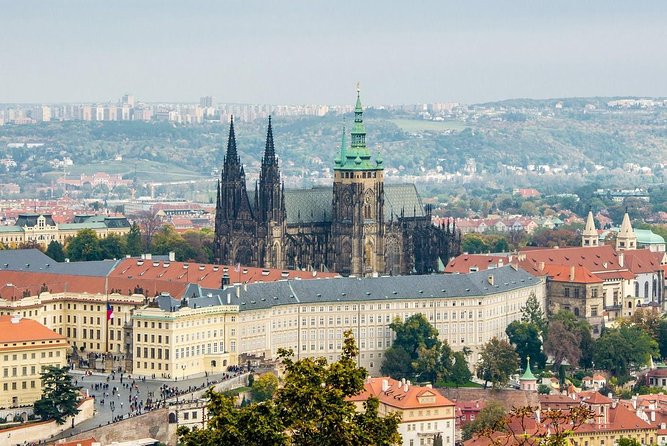
The heart of the tour begins at Prague Castle, one of Europe’s great complexes with roughly 1,100 years of history behind it. You go up through the castle approach areas and across the Royal Garden, including the area over the Stag Moat. Then you move through the castle spaces where different rulers rebuilt, renovated, and rebranded the place.
The guide’s role here is crucial: the castle’s story is not linear. Romanesque forms appear, Gothic expansions take over, then you see Baroque, Rococo, Renaissance, and Neoclassical monuments woven into the same overall site. That mix can be confusing on your own, because it is not obvious why buildings look like they belong to different centuries.
You also get the political backstory that explains why so much went wrong and right over time, including periods of artillery attacks and plundering, as well as deterioration under later rulers. When you hear that while standing in front of the architecture, the stones stop feeling random.
If you can choose, I lean toward an afternoon timing when schedules allow. The castle complex is often less crowded later in the day, which makes the walking flow and interior viewing more comfortable.
Royal Garden stops: Ball Game Hall and Queen Anne’s Summer Palace
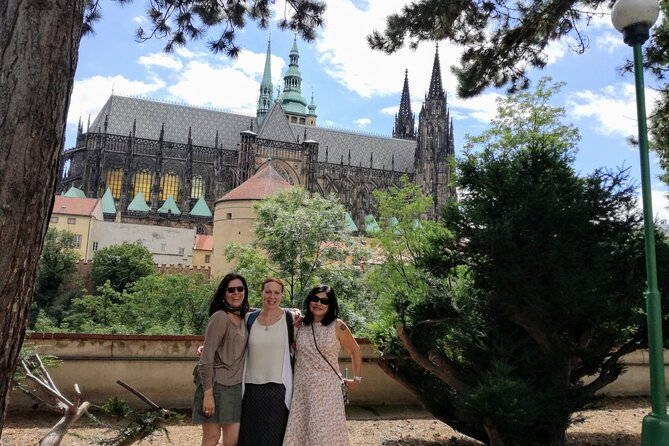
After the castle approach, you spend short focused moments in the Royal Garden area, hitting highlights that are easy to miss if you only chase the big church names.
Ball Game Hall is a great example. You pass the Renaissance Ball Game Hall, where the story goes that aristocrats played tennis with the Emperor. Even if you care more about architecture than sports, it is a memorable way to understand how Renaissance power expressed itself in culture and leisure. You also see the Renaissance sgraffito with allegories connected to virtues, arts, and sciences.
Then comes Queen Anne’s Summer Palace, described as a Renaissance work outside Italy. This is a stop that rewards curious travelers because it is not only pretty, it is also weird in a good way. It was commissioned by Ferdinand I in the mid 1500s and later converted into an astronomical observatory by Rudolf II. The names connected to that scientific era include Tycho de Brahe and Johannes Kepler, and the story also notes the emperor died here after losing the royal title.
These garden pauses are brief, but they add texture. Prague Castle is sometimes treated like a single monument. Stops like these remind you it was also a working residence, a cultural stage, and a place where rulers tried to shape the world through art and science.
St. Vitus Cathedral: Gothic scale and royal burials
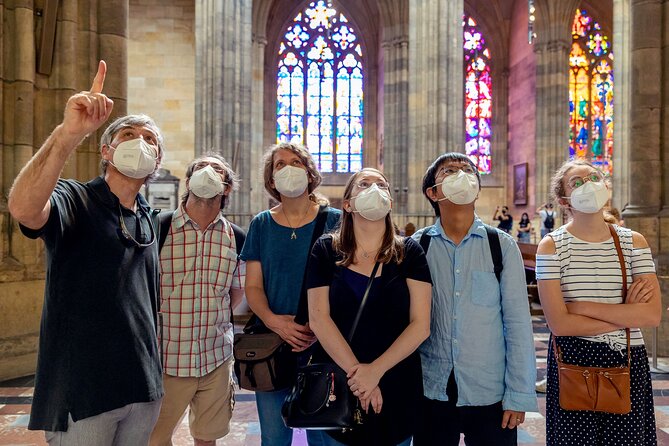
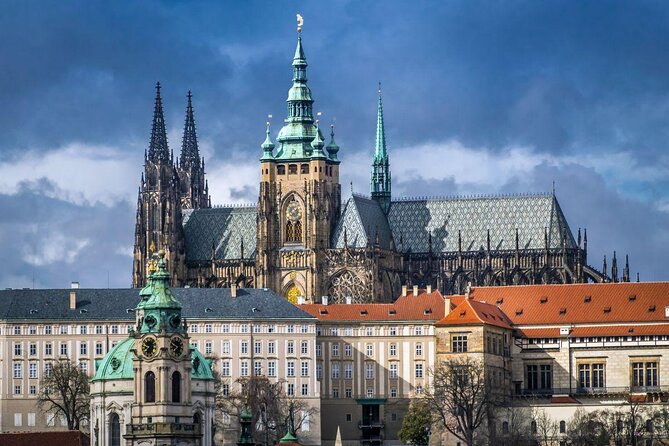
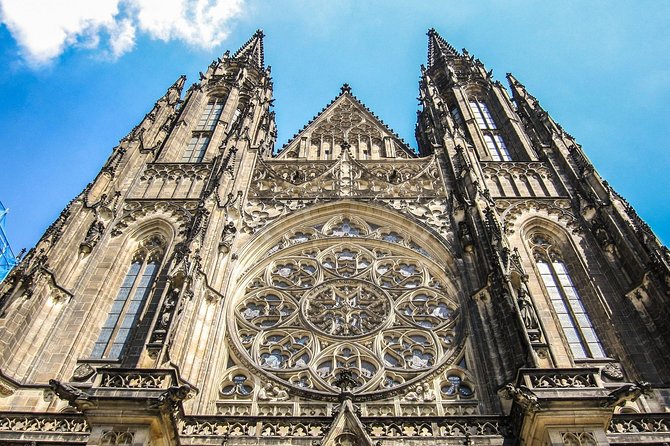
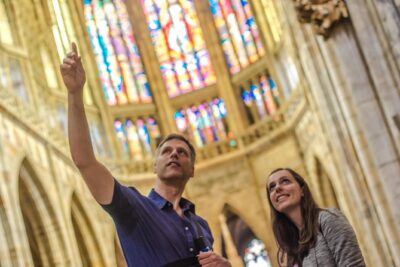
St. Vitus Cathedral is one of the most important Gothic monuments in Central Europe, and it is also the kind of place where a guide helps you look longer, not just walk through.
You spend about 30 minutes here, learning how the cathedral’s construction stretched from the first half of the 14th century until completion roughly 600 years later in the first half of the 19th century. That timeline alone can explain why cathedrals feel both uniform and layered at the same time.
The cathedral is also tied to royal burial space. You learn about the royal crypt of Czech sovereigns and patron saints. Two specific features are called out: the baroque tomb of St. John of Nepomuk, described as cast in silver, and the Gothic St. Wenceslas Chapel, which houses relics of the saint.
One important practical note: St. Vitus Cathedral admission is not included in the tour price. So you should expect to pay the cathedral ticket on top of your tour cost. If you know you want extra time inside the cathedral for photos or quiet, morning might fit better. If you prefer a smoother flow with fewer people, afternoon is often easier.



Old Royal Palace and Vladislav Hall: where power got theatrical
The tour then moves into the ceremonial and political spaces of the castle, especially the area around Vladislav Hall. This is where you can feel how architecture served politics, not just aesthetics.
Vladislav Hall was built in the late 15th century and combines Late Gothic with Renaissance style. You learn it hosted coronation festivities, banquets, and even knight tournaments. The guide also points out the Riders’ Staircase, designed so knights could enter the hall in full armor and on horseback, which is exactly the kind of detail that makes a guide worth it.
You also visit the Ludwig Wing, which leads to a story with serious consequences: the window where members of the Czech Estates defenestrated two Austrian governors and their scribe, sparking the Thirty Years’ War. Whether you know the war already or you are learning it now, it connects a single doorway to one of Europe’s most destructive conflicts.
Another practical detail: Old Royal Palace admission is not included. Plan for that in your budget. Also, if you are sensitive to crowds, you may want to time your inside stops carefully since ticketed interiors can create bottlenecks.
St. George’s Basilica and the style contrast
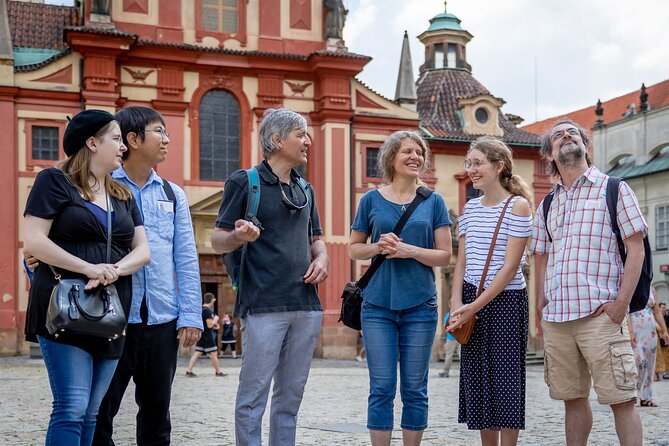
Right after St. Vitus, the tour includes St. George’s Basilica as a contrast stop. Here you compare what you just saw in Gothic scale with an earlier Romanesque style from the 1100s.
This short stop, about 10 minutes, is valuable because it makes the architecture differences stick. Romanesque interiors tend to feel more solid and weighty, while Gothic structures emphasize height and rhythm. When you see them back to back in the same day, you start recognizing style cues without needing to memorize names.
Admission for St. George’s Basilica is also not included, so expect another ticket purchase if you want to enter rather than just pass by.
Golden Lane and the story of Rudolf II’s guards
Golden Lane is one of those places that feels tiny compared to the castle around it, which is part of why it is so popular. You walk through this diminutive street, originally built in the 16th century to house Rudolf II’s castle guards.
Because the lane is small, your guide’s explanations help you avoid the common mistake of treating it like a souvenir corridor only. You learn that inside are tiny rooms, and you can also access a museum of medieval armor within a former 14th-century fortification connected to the lane.
There is also a darker connection: Golden Lane is linked with Dalibor Tower, described as a former dungeon. That detail changes how you view the street, because you start thinking about control, imprisonment, and power rather than only court life.
Golden Lane admission is not included, so if you want the museum parts, factor in extra entry costs.
After the castle: Domeček and Strahov Monastery in Hradčany
Once your time inside the castle ends, you continue into Hradčany and nearby sights, which helps the tour feel like a bigger story instead of a checklist.
You pass by Domeček, described as a former prison where political opponents were imprisoned by the Gestapo. It is a heavy stop, but it adds a modern historical layer to the hill, showing how this same area has been used for power long after medieval courts.
Then you reach the Strahov Monastery, where an ancient library is housed. This is a calmer counterpoint to the castle interiors and the palace drama. Even if you only see the monastery area from what you are able to access on the walk, it gives your day a sense of Prague as a place of ideas, records, and memory.
The total effect is that the tour keeps your momentum moving while still giving you real historical context beyond the postcard stops.
Price and value: what you are paying for, and what you still need to budget
At $126.16 per person, you are buying the historian guide and a timed route through the castle complex highlights. That can be good value if you want a small group, a clear path, and explanations that connect architecture to political and religious change.
But you are not buying entry into everything. The tour explicitly does not include Prague Castle entrance tickets, listed as CZK 450 for adults and CZK 300 for students and seniors. It also does not include admission for multiple interiors, including St. Vitus Cathedral, Old Royal Palace, St. George’s Basilica, and Golden Lane.
Food and drinks are also not included, and there is no hotel pickup or drop-off. That means you should bring water or plan on buying something near your meeting point or after the tour.
A smart strategy: decide early whether you want to go all-in on interiors. If yes, set aside extra time and budget for tickets. If you mainly want the architecture and guided explanations, you might still want to enter the major interior spaces, since those are where the guide’s stories land the hardest.
Finally, this tour is booked on average 40 days in advance. That is a clue it stays popular, especially in peak seasons, so it is worth reserving sooner rather than later.
Who this tour suits best
This is a strong fit if you are a curious history person who wants architecture explained in plain language. It is also a great match if you dislike huge groups. With a max group size of 8, you are less likely to lose the guide under noise.
You may want to choose this tour if you:
- Like architecture variety and want help spotting Romanesque, Gothic, Renaissance, and more
- Want a guided route that reduces decision fatigue at Prague Castle
- Prefer afternoon timing for easier crowd conditions
- Appreciate political storytelling, including famous events tied to specific places
If you are the kind of visitor who wants complete freedom to wander at your own pace with no ticket budgeting, you might feel the tradeoff is too structured. In that case, you could consider independent sightseeing. But for most people, the small-group structure and historian context make the castle manageable.
Should you book this Prague Castle walking tour?
I think this is a good booking if you want a guided, small-group path through Prague Castle that turns architecture into understanding. The price is only truly fair once you add in separate admissions, so budget for those tickets in advance. If you do that, you get a well paced route, clear stop-by-stop focus, and a guide who can make the place feel connected, not chaotic.
If you love hearing the stories behind buildings, especially royal halls, cathedrals, and the symbolic corners of Golden Lane, this tour is likely to give you the Prague Castle experience that stays with you.
FAQ
How long is the Prague Castle Walking Tour?
It runs for about 3 hours.
Where does the tour meet?
You meet at Bagel Lounge MalostranskáLetenská 118/1, 118 00 Praha 1-Malá Strana, Czechia.
What is included in the tour price?
The tour includes a historic guide.
Is the Prague Castle entrance ticket included?
No. Prague Castle entrance is not included. Adult ticket price is CZK 450, and students and seniors pay CZK 300.
Are food and drinks included?
No. Food and drinks are not included.
How many people are in the group?
The group has a maximum of 8 people.
Is the tour offered in the morning and afternoon?
Yes, you can choose between morning or afternoon timings.
Are there additional admission tickets inside the castle complex?
Yes. Admission tickets are not included for stops such as St. Vitus Cathedral, Old Royal Palace, St. George’s Basilica, and Golden Lane.
Do I get a mobile ticket and confirmation when booking?
Yes. The tour uses a mobile ticket, and confirmation is received at the time of booking.
Can I cancel for a full refund?
Yes, you can cancel for a full refund if you cancel at least 24 hours before the experience’s start time.
More Walking Tours in Prague


More Tours in Prague

More Tour Reviews in Prague
Not for you? Here's more nearby things to do in Prague we have reviewed










Prague Castle Tours, compared.
 ★ 4.7Prague Castle 2.5-Hour Tour Including Admission TicketFrom $578,927 reviews
 ★ 4.73-Hour Walking Tour of Old Town & Prague CastleFrom $305,696 reviews
 ★ 4.83-Hour Old Town and Prague Castle Tour in GermanFrom $365,671 reviews
 ★ 4.4Prague Castle and Lobkowicz Palace Entry TicketsFrom $385,066 reviews
 ★ 5.0Prague 3-hour Afternoon Walking Tour including Prague CastleFrom $531,899 reviews
 ★ 4.5Prague Castle Tour Including Admission Ticket – 2.5 HourFrom $591,171 reviews
 ★ 4.6Prague Castle: Midday Classical Concert at Lobkowicz PalaceFrom $281,106 reviews
 ★ 4.0Full-Day Prague Tour with Prague Castle, Lunch and Vltava CruiseFrom $75921 reviews
Browse the lists this tour appears in